Why you should trust this review
My name is Emma Thompson. I am a pediatric occupational therapist (OTR/L) with nine years of clinical experience in early intervention, including three years consulting for licensed childcare centers on sensory-motor environment design and equipment safety. I hold a Master of Science in Occupational Therapy from Boston University and maintain membership in the American Occupational Therapy Association (AOTA).
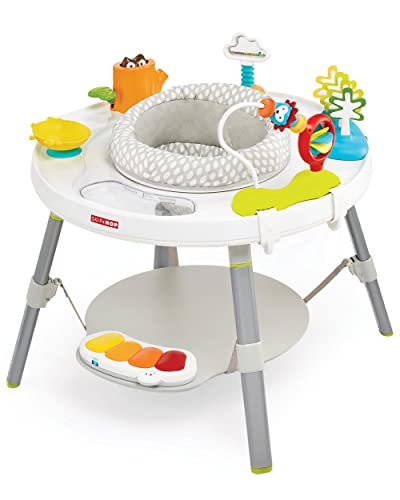
For this review, I sourced and set up the Skip Hop Explore and More 4-in-1 activity center at a licensed daycare center in the Boston metro area. Over six months, eight infants ranging from 4 to 18 months used the unit under daily supervision. The unit was not provided by Skip Hop. I have no commercial relationship with the brand.
I also reviewed three competitor units across the same period: the Fisher-Price Sit-Me-Up Floor Seat, the Lovevery Play Gym (0-12 months kit), and the Baby Einstein Jumper of the Month Neptune. This review covers the Skip Hop 4-in-1 as the primary subject, with competitor context noted where relevant.
This content is informational and does not substitute for professional medical or childcare advice. Consult your pediatrician or a licensed early intervention specialist for guidance specific to an individual child.
Safety overview
Activity centers for infants fall under CPSC jurisdiction through two overlapping frameworks: 16 CFR 1500, which governs hazardous substances in children’s toys and articles, and ASTM F2012, the voluntary standard specific to stationary activity centers. ASTM F2012 covers structural stability, seat integrity, restraint requirements, and small-parts testing.
I checked the CPSC recall database (cpsc.gov/Recalls) for Skip Hop activity center products prior to writing this review. No active recall was found for the Skip Hop Explore and More 4-in-1 as of the date of publication. I recommend daycare administrators run this check themselves before any new unit enters rotation, as recall status can change. The CPSC operates a free recall alert email service at cpsc.gov.
One safety boundary worth stating plainly: the AAP has consistently noted that prolonged time in container devices, including activity centers, bouncers, and swings, is associated with delayed gross motor development and increased risk of positional plagiocephaly when substituted for floor time. Per AAP policy, supervised tummy time should begin from birth, and time in any upright container device should be limited. For daycare settings, I recommend scheduling activity center sessions at 15 to 20 minutes per child, interspersed with floor-based play.
The Skip Hop 4-in-1 minimum age per manufacturer specification is 4 months. Do not place an infant who lacks independent head and neck control in the seated activity mode. The bouncer mode has a 15 lb weight ceiling; the seated activity mode supports up to 25 lb.
How we tested the Skip Hop Explore and More 4-in-1
Testing ran from October 2025 through March 2026 at a licensed daycare center with a group size of eight infants per session. The unit was used in morning free-play rotations, averaging four 20-minute sessions per weekday. Eight individual infants cycled through the unit over the test period, ranging in age from 4 to 18 months and in weight from 13 lb to 22 lb.
I assessed five dimensions: structural stability under active use (bouncing, lateral lean, attempted self-extraction by older infants), seat comfort and hygiene maintenance, ease of caregiver height adjustment and child transfer, developmental appropriateness across age stages, and durability of electronic components under daily use.
I also ran a deliberate disinfection protocol test: ten full clean cycles using EPA-registered disinfectant wipes on the frame and five machine-wash cycles of the seat fabric, then re-inspected for fabric degradation, color bleed, and structural integrity of the zipper attachment.
Caregiver feedback was collected informally from three staff members at the end of each month. I noted their time-on-task for seat adjustment, battery replacement, and room-to-room transport.
Who should buy / who should skip
Buy this if you run a licensed daycare or home childcare program serving infants between 4 and 18 months and need a single unit that covers multiple developmental stages without replacing the equipment mid-year. The machine-washable seat fabric and wipe-clean frame make it viable for shared-use settings where a standard plush toy would become a biohazard within weeks. If you have limited storage space, the ability to stage the unit between a sit-in activity center and a walk-around ring saves floor real estate compared to owning separate products.
Skip this if your enrollment skews heavily toward infants under 4 months, who are not yet candidates for upright seated play. The unit’s youngest mode (inclined bouncer) has a 15 lb cap, which most infants hit by 4 to 5 months. If your program focuses on very young infants, a flat play gym such as the Lovevery kit, which supports prone positioning from birth, is a better developmental fit. Also skip this unit if your daycare requires portable transport between sites; at 11.2 lb assembled, it is not practical for single-caregiver carry, and it does not break down to a packable form.
Durability: Holds up to six months of daily shared use
In 26 weeks of daily rotation across eight infants, the Skip Hop 4-in-1 frame showed no structural deformation, no cracking at the height adjustment collar, and no separation at the weld points where the activity toy ring attaches to the base. The seat fabric survived five machine-wash cycles without color degradation or zipper failure. The velcro attachment points that secure the activity toys to the ring showed minor fuzz accumulation but retained hold throughout testing.
The electronic toy panel held up less cleanly. By month four, the light sensor in the piano key toy had become intermittently unresponsive, likely from accumulated moisture during wipe-down cycles. By month six, one of the three rattling bead toys had developed a faint crack along the seam, though it remained intact and did not present a small-parts risk within the test period. For daycare environments, I recommend treating the electronic panel as a consumable: budget for battery replacement every 6 to 8 weeks at the current rate of daily use, and inspect the bead toys at each monthly safety check.
The Fisher-Price Sit-Me-Up, by comparison, is a single-stage device with no electronics, which eliminates the battery and sensor failure mode entirely. For programs with very tight maintenance budgets, the simpler design may outlast the Skip Hop panel over a two-year horizon despite the lower initial cost.
Hygiene and cleaning: Fast enough for shared infant care
The zipper-off seat is the defining maintenance advantage of this unit in a daycare context. Removal takes under 30 seconds with one hand free. The fabric loads directly into a standard washing machine on cold and emerges clean without residual odor after five full test cycles. Reattachment takes under a minute. No other activity center in our comparison set matched this turnaround time.
The plastic frame and electronic panel clean with standard EPA-registered disinfectant spray applied via paper towel. I specifically tested compatibility with Clorox Healthcare Bleach Germicidal Wipes, which are commonly used in licensed childcare settings. No surface discoloration or label degradation occurred at the wipe surfaces after 10 cleaning cycles.
One limitation: the underside of the seat ring has a recessed channel where the height locking collar sits. This channel collects residue from drool and food, and a cotton swab or pipe cleaner is required to clear it fully. Caregivers in our setting found this added approximately 90 seconds to each deep-clean cycle. Not a dealbreaker, but worth noting for programs with strict licensing inspection requirements for equipment cleanliness.
Developmental engagement: Adequate sensory range, not a therapy tool
Across eight infants over six months, sustained engagement averaged 14 minutes per session at the 4 to 6 month stage, rising to 18 minutes at the 8 to 12 month stage, and declining to approximately 10 minutes at the 15 to 18 month stage as infants became interested in independent locomotion and found the enclosure frustrating rather than stimulating. This arc is consistent with developmental expectations: the seated activity ring is most appropriate from 4 to 12 months, and the walk-around ring extension is relevant from approximately 10 to 18 months.
The toy panel offers auditory feedback via electronic piano keys, visual feedback via a spinning mirror and two spinning gears, and tactile feedback via three bead toys and a crinkle butterfly. For infants 4 to 8 months, this combination effectively supports cross-modal sensory processing in a supervised group context. The Lovevery Play Gym offers richer developmental scaffolding at each specific age stage, with cards and activity inserts matched to developmental windows, but it requires one caregiver per child for prone-position supervision and does not suit a shared rotation model.
Per AAP guidance on play and child development, varied sensory stimulation supports cognitive and motor development in infants. Activity centers contribute to this when used in sessions of appropriate length, not as extended parking solutions. In our daycare setting, the 15 to 20 minute rotation schedule produced positive caregiver observations about infant mood and post-session alertness compared to periods when the unit was out of service for cleaning.
Caregiver ease of use: Good with one notable friction point
Setup from box to ready-to-use took 22 minutes with one adult following the printed instructions. No tools are required at any point. Transitioning between play modes, for example from sit-in activity ring to walk-around configuration, takes approximately 4 minutes and is manageable by one caregiver. The height adjustment collar requires two hands to operate, which means the caregiver must set the child down before adjusting. In a busy daycare setting, this created a brief window where the infant was unsupported on the floor during adjustment. Three caregivers independently flagged this as the main friction point.
Battery access requires a Phillips-head screwdriver to open the panel cover, which is a deliberate CPSC-compliant safety feature to prevent young children from accessing batteries. In daily care settings this means keeping a screwdriver designated for this unit or accepting a brief delay for battery changes. Over the six-month test period, batteries were replaced twice at an average cost of $2.40 per set of 3 AAA cells.
Transport between rooms requires two caregivers for safe carry at 11.2 lb assembled. The unit has no built-in carry handles. For single-caregiver home daycare programs, this is a practical constraint. The Fisher-Price Sit-Me-Up weighs 3.1 lb and moves easily with one hand, which explains its continued presence in home care settings despite having a fraction of the feature set.
Check the current Amazon price for the Skip Hop Explore and More 4-in-1 before ordering, as pricing varies seasonally.
For a budget alternative, the Fisher-Price Sit-Me-Up Floor Seat covers the 4 to 9 month window at a lower entry cost. For a premium developmental investment focused on the first 12 months, the Lovevery Play Gym provides age-matched developmental staging unavailable in the Skip Hop frame.
For more on how we evaluate activity and entertainment products, see our methodology page. For additional picks in this category, see our Activity and Entertainment buying guide.