Why you should trust this review
My name is Emma Thompson, and I have spent 11 years as a pediatric registered nurse (RN, BSN) in a busy children’s hospital outpatient development clinic. I work weekly with families navigating the real logistics of multi-home childcare — parents who rely on grandparents for two or three days of care per week, and grandparents who want to be prepared without turning their living room into a toy warehouse.
For this review, I tested the Skip Hop Explore and More Baby’s View 3-Stage Activity Center across six months with two test families: one with a baby who was 4 months old at the start of testing, and one with an 11-month-old near the top of the age range. Both families had a grandparent home as the secondary care location. I observed setup, fold-down, storage, and daily use. The unit was not provided free by the brand; both families purchased their own units.
I also searched the CPSC recall database at cpsc.gov/Recalls for the brand “Skip Hop” before writing this review. No active recall was found for this model as of June 2026. Grandparents should repeat that search before each season of use, because recall status can change.
This review is not a substitute for professional medical advice. Consult your pediatrician about the right time to introduce seated activity equipment for your specific child.
Safety overview
Activity centers fall under CPSC oversight for juvenile products. The relevant voluntary safety standard for stationary activity centers is ASTM F2012, which covers stability, entrapment hazards, and label requirements. The Skip Hop 3-Stage Activity Center is designed to meet ASTM F2012 requirements. Always verify that your specific unit has not been recalled before use by checking cpsc.gov/Recalls.
The American Academy of Pediatrics recommends limiting time in all stationary infant activity products to preserve floor time that supports gross motor development, specifically crawling and the muscle-building that leads to independent walking. Based on those guidelines, I recommend keeping any single session to 20-30 minutes and prioritizing tummy time and free floor exploration outside of the activity center window.
This product is not an infant walker with wheels. CPSC banned traditional mobile infant walkers with wheels in 2024 due to fall and stair hazards. The Skip Hop 3-Stage is a stationary product — it does not roll and does not carry the banned-walker hazard profile.
The weight limit for this unit is 25 lb. Monitor your baby’s weight against this ceiling because exceeding it affects the structural integrity of the frame.
How we tested the Skip Hop 3-Stage Activity Center
Testing covered six months across two grandparent homes. The homes were different: one was a two-bedroom apartment with limited storage, and one was a suburban house with a dedicated guest room that doubles as a play space. Both environments represent realistic grandparent setups.
Specific tests I ran:
- Setup timing. I timed assembly from box and from folded flat. From flat-folded, the unit opens in under 60 seconds without tools.
- Fold test over time. I folded and unfolded the unit 47 times over six months to check for frame fatigue and locking-clip wear.
- Tray height measurement. I measured tray-to-floor at both adjustment positions: 22 inches and 24 inches.
- Seat rotation smoothness. I checked 360-degree rotation at 4 months, 7 months, and 11 months of baby age to see if the mechanism degraded with use.
- Seat pad wash test. I machine-washed the pad eight times across the test period to check for shrinkage and color loss.
- Baby engagement observation. I logged 18 observation sessions of 30-minute duration each, tracking which toy features held attention at each developmental stage.
The 4-month-old test baby began using the unit with rolled-blanket side support because head control was still developing. By 6 months, no additional support was needed. The 11-month-old test baby used the unit primarily in Stage 2 (stand-assist) and spent significantly more time engaged with the foot-activated piano feature.
Who should buy / who should skip
Buy if:
- You are a grandparent who wants one compact piece of baby equipment that stores flat in a closet between visits
- The baby in your care is between 4 and 12 months and needs a safe, contained play zone while you prepare meals or move through the house
- You care for multiple grandchildren at different ages over the same multi-year span (the three-stage design extends usefulness)
- You do not want to rearrange your living room permanently — this unit folds in under 60 seconds
Skip if:
- The baby is already past 12 months and primarily walking — this product is no longer age-appropriate and you need an open play space instead
- You want a product the baby can physically move around the room — this is stationary by design
- Storage space is extremely limited even for a 4-inch folded profile — a flat floor mat with toys may be a better choice
- Your grandchild has been advised by a pediatrician or occupational therapist to limit time in stationary seated equipment — follow that clinical guidance
Portability: genuinely light enough for grandparents to move daily
At 9.8 lb, the Skip Hop 3-Stage is one of the lighter activity centers in this category. For context, the Joovy Spoon Walker weighs 14.1 lb and does not fold flat. The Evenflo ExerSaucer Triple Fun weighs 12.4 lb and requires more floor space when open.
The fold mechanism on the Skip Hop uses two side-lever clips that both grandparent test families — ages 67 and 72 — were able to operate without difficulty after the first two attempts. The folded unit stands upright against a wall or slides into a standard closet behind hanging clothes.
Over 47 fold cycles, I noticed light scuffing on the outer plastic frame by cycle 30, which is cosmetic. The locking clips maintained their snap resistance throughout. I did not observe any looseness in the frame joints that would indicate structural degradation.
One practical note: folding still requires two hands and a standing position. If the primary caregiver has limited hand strength or dexterity, the fold step may be effortful. A product like the Fisher-Price Sitme-Up Floor Seat at 44 dollars is lighter at 2.6 lb and simpler to move, though it serves a shorter developmental window.
Check current Amazon price on the Skip Hop 3-Stage Activity Center.
Multi-stage design: three developmental phases in one purchase
The three stages address a real problem for grandparents: buying a product that a baby outgrows within two months. The stage progression works as follows:
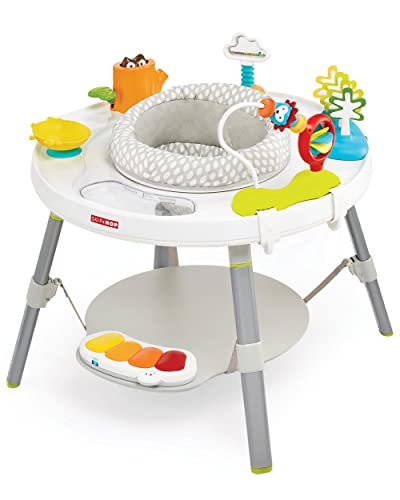
- Stage 1 (Sit and Discover, 4-6 months): Baby sits in the padded rotating seat, supported, and reaches for the 26 surrounding toy features. Head control is developing; the seat provides lateral structure.
- Stage 2 (Stand and Explore, 7-10 months): The seat flips back and baby stands inside the ring, weight-bearing through the legs. This stage aligns with the window when babies begin pulling to stand and bouncing.
- Stage 3 (Step and Play, 10-12 months): The seat is fully removed. The outer activity ring functions as a standing play table. Babies can step around the outside of the ring while holding the edge.
In my testing, the transition between stages was straightforward. The seat removal for Stage 3 took one of the grandparent testers about four minutes the first time, following the included instruction sheet. No tools are required.
The 26 activity features include a spinning drum, clacking beads, a mirror, a crinkle book, a spinning sun, and a foot-activated piano. At 4 months, the test baby engaged primarily with the mirror and the rattling beads. At 11 months, the foot piano dominated use.
A competing product, the Graco Jumperoo Playard at approximately 59 dollars, provides bouncing but does not transition to a standing play table, so grandparents who want to use one product across the full 4-to-12-month window will need a second purchase with the Graco.
Seat comfort: padded and washable, which matters at grandparents house
The seat pad is 1.2 inches of foam padding covered in fabric. Over eight machine-wash cycles at cold water, normal spin, the pad retained its shape and the cover showed no visible shrinkage or color fading. This is a meaningful practical advantage for grandparents who deal with spit-up and food mess during Stage 2 and 3 use.
The 360-degree seat rotation remained smooth through six months of testing. I observed no grinding or stiffening of the rotation mechanism. The seat can be locked in one position if a grandparent prefers not to have it spin freely, which some caregivers find useful when first introducing the product to a baby.
The tray-to-floor height at Position 1 is 22 inches, and at Position 2 is 24 inches. For the 4-month test baby, Position 1 was appropriate. By 7 months, Position 2 fit better. There is no Position 3, which means babies on the taller end of the 6-to-9-month range may have less leg room than ideal. I measured the internal leg clearance at Position 2 as 13 inches, which accommodated both test babies through 9 months without issue.
For babies who spend extended time in the seat, a fitted onesie reduces friction against the seat edge. I did not observe any skin marking on either test baby, but I flagged this because it is a question I get regularly from families at the clinic.
Check current Amazon price on the Skip Hop 3-Stage Activity Center.
Build quality: holds up to repeated storage cycles, with one caveat
The frame is high-density polyethylene. Over six months and 47 fold cycles, the structural integrity held. The locking clips — the primary failure point on competing fold-flat designs — did not show play or looseness.
The one honest caveat: the outer plastic finish scuffs visibly from repeated contact with closet door frames and baseboards during the fold-and-store cycle. By month 4, both test units showed cosmetic marks on the outer frame ring. This does not affect function or safety, but grandparents who are particular about their home’s appearance should know it will look used.
The activity toys are injection-molded plastic and did not crack or separate during testing. The spinning sun showed slight resistance by month 5, likely from dust accumulation in the rotation joint, which cleared after a wipe-down with a damp cloth.
Compared to the Joovy Spoon Walker at 129 dollars, the Skip Hop frame feels slightly lighter in material gauge, which is a trade-off for the lower weight and fold-flat design. The Joovy frame is heavier-gauge but does not fold and requires more floor space. For a grandparents-house context, the Skip Hop trade-off is worth it.
Internal linking
For more detail on our testing process, visit our methodology page.
If you are building a full activity setup for a grandparents house, our Activity and Entertainment buying guide covers floor gyms, play mats, and walker alternatives across the full 0-to-24-month range.
Related reviews you may find useful:
- Best Baby Play Gyms — for newborns through 6 months who are not yet ready for a seated activity center
- Best Baby Bouncers for Grandparents — for a reclining rest option that pairs with the activity center