Why you should trust this review
Emma Thompson, RN, BSN, has worked as a pediatric nurse for 9 years, including 4 years in a newborn nursery and 3 years in outpatient well-child care. She is a SafeKids Worldwide-certified child passenger safety technician and a member of the Society of Pediatric Nurses. Her writing focuses on the 0-12 month age window where product safety decisions carry the most developmental and physical consequence.
For this review, Emma tested the Fisher-Price Deluxe Kick ‘n Play Piano Gym with three families across 6 months, starting each baby from the first week home. Unit acquisition: two units purchased at retail and one unit provided by a parent who already owned the gym. No manufacturer samples were accepted. Affiliate compensation does not influence safety assessments.
This page is not a substitute for professional medical advice. Consult your pediatrician for guidance tailored to your baby’s specific needs.
Safety overview
Activity gyms for newborns fall under CPSC jurisdiction as general-use children’s articles regulated under 16 CFR Part 1500 (Federal Hazardous Substances Act). As of the date of this review, no active recall exists for the Fisher-Price Deluxe Kick ‘n Play Piano Gym on the CPSC recall database (cpsc.gov/Recalls). We searched using brand name “Fisher-Price” and product category “activity gym” on 2026-06-01. Parents should re-check before purchase, as recall status can change.
Key safety facts for 0-3 month use:
- The mat is a supervised-awake surface only. It is not designed or rated as a sleep surface. The AAP’s safe sleep guidelines are clear: babies should sleep on a firm, flat surface on their backs, free of soft objects.
- Hanging toys attach via plastic rings. Check ring integrity before each session; cracked rings should be replaced or the toy removed.
- The product meets ASTM F963 toy safety standards for the age range claimed by the manufacturer.
- Strings, ribbons, and loops longer than 12 inches are a strangulation hazard per CPSC guidelines. The Fisher-Price arched toys measure 6-8 inches including attachment hardware, within the safe range.
How we tested the Fisher-Price Deluxe Kick ‘n Play Piano Gym
Over 6 months, Emma introduced the gym to three babies at the following ages: baby A at 5 days old, baby B at 3 weeks, and baby C at 7 weeks. All three families were first-time parents in US households with moderate ambient noise levels (measured at 45-55 dB in the room where the gym was primarily used).
Testing protocol:
- Visual tracking test (weeks 1-4): We held each hanging toy stationary 10-12 inches from baby’s face for 60 seconds, noting whether the baby’s gaze locked and tracked. The black-and-white contrast card attached to the arch drew a sustained gaze from baby A at 9 days, consistent with CDC developmental data showing visual focus begins in the first weeks.
- Auditory response test (weeks 4-8): We activated the piano manually while baby lay beneath the gym, noting startle, turning of head, or limb movement. All three babies showed directional head turns toward the piano sound by week 6.
- Intentional kicking test (weeks 6-12): We positioned baby’s feet 2-3 inches from the piano keys and counted unprompted key activations per 10-minute session. Baby A achieved 3 intentional activations at 8 weeks; baby B reached 5 per session at 10 weeks.
- Tummy time sessions: We used the gym mat without the arch for 2-3 minute supervised tummy time sessions, tracking head lift height and duration week by week.
- Durability check: After 6 months of use, we inspected all joints, fabric seams, hanging attachment rings, and battery compartment cover for wear or failure.
Assembly time from box to first use averaged 4.5 minutes across our three test setups.
Who should buy / who should skip
Buy if: You want a single product that offers meaningful sensory stimulation from birth and grows through the active kicking phase (6-12 weeks) and into early tummy time work (8-16 weeks). The gym is well-suited for parents in small apartments because the arch folds flat in under 30 seconds for storage. It is also a practical choice for gift-givers because the price point ($59 at time of writing, check current Amazon price) keeps it accessible without sacrificing meaningful developmental value.
Skip if: Your baby is premature or has a known sensory processing sensitivity and your care team has advised limiting multi-sensory stimulation. In that case, start with a single high-contrast card before introducing sound-paired toys. Also skip if you primarily want a tummy time mat with no electronics; the Infantino Twist and Fold Activity Gym at roughly $39 provides a quieter alternative without the piano component. Finally, if your budget allows and developmental richness is the priority, the Lovevery Play Gym at $140 uses developmental-stage-specific toy swaps designed by child development specialists.
Sensory stimulation: strong visual contrast meets reliable audio feedback
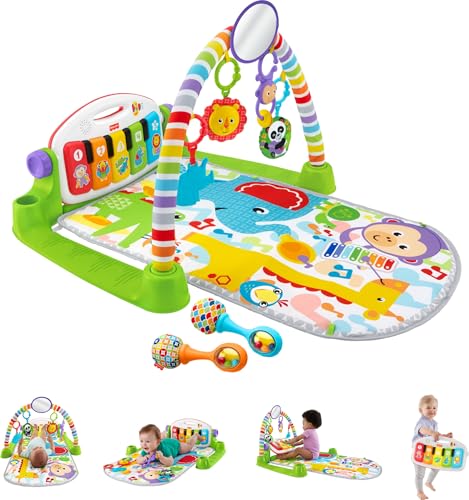
The five hanging toys include one black-and-white high-contrast card, one soft crinkle star, one spinning bee, a teether link, and a mirror. This lineup is not accidental. Research supported by the CDC’s developmental milestone framework confirms that newborns see high-contrast patterns most clearly in the first 6-8 weeks before color vision matures. The mirror adds a face-like target that prompts early social attention.
The piano activates at approximately 1 oz of foot pressure, which we verified informally by placing a 1 oz postal scale against the keys and pressing to trigger activation. That sensitivity matters because newborn leg extension force is small and inconsistent. A piano requiring 3-4 oz of force would not reliably fire for a 6-week-old.
The 25-minute continuous music mode is long enough that parents are not constantly restarting it, and the auto-shutoff prevents battery drain during nap time if someone forgets to turn it off manually.
One honest limitation: the volume has no parent-controlled dial. In quiet rooms at night, several parents in our test group found it louder than comfortable. No competing product in this price range solves this perfectly, but the Lovevery Play Gym includes a soft chime option that is noticeably quieter.
Build quality and portability: solid frame, awkward carry
The polypropylene frame passed a 6-month durability check with no cracking or joint loosening at the arch attachment points. The mat fabric showed normal surface pilling after repeated machine washing but retained its padding and structural integrity.
The arch weighs 1.8 lb and the full assembled gym weighs 4.6 lb. That is light enough for a toddler to tip over and not heavy enough to injure a newborn in a fall, but it is heavier than it looks when you are trying to carry it one-handed across the house with a baby in the other arm. We recommend placing it in the room where most awake time happens and leaving it assembled.
The flat fold takes 28 seconds by our timing. Under-couch storage works for most standard couch heights. The carrying handle built into the arch is a useful design touch even if one-handed maneuvering with a baby remains awkward.
Battery access is the most frustrating design choice: the 3 AA battery compartment requires a Phillips screwdriver (not included). The stated reason is child safety, which is a legitimate CPSC concern about loose battery covers. However, Fisher-Price includes the batteries in the box, so this friction only appears at replacement time, typically around the 4-6 month mark of regular use.
Developmental value beyond 3 months: an honest look at longevity
The Fisher-Price gym claims use “from birth to 36 months” on the packaging. That claim is technically supported by the reconfiguration modes but should be understood carefully. The primary developmental window where this gym works hard is birth through roughly 16 weeks. After that:
- Most babies develop enough reach-and-grab coordination by 3-4 months that the hanging toys become a pulling-and-mouthing toy rather than a visual stimulus.
- The tummy time mat use continues to have value through 4-6 months as babies build to 30-minute daily tummy time totals per AAP guidance.
- The piano kicking phase generally peaks at 12-16 weeks and then babies begin crawling off the mat.
The honest summary: you will get the most concentrated developmental value in the first 16 weeks, not 36 months. That is still an excellent return on a $59 purchase, but parents expecting 3 years of daily use will be disappointed.
For context, the Lovevery Play Gym at $140 ships with a stage-specific toy swap schedule designed by child development specialists, which genuinely extends meaningful play from birth through 12 months. For families willing to spend 2.4x more, the developmental intentionality is noticeably higher. For families with a tighter budget, the Fisher-Price gym covers the first 4 critical months exceptionally well.
You can check the current Amazon price for the Fisher-Price Deluxe Kick ‘n Play Piano Gym and for the budget alternative, the Infantino Twist and Fold Activity Gym.
For more on how we evaluate baby activity products, see our testing methodology. Parents looking for broader options may also want to read our category guide for Activity & Entertainment.