Bringing a premature baby home is one of the most joyful and nerve-wracking transitions a parent can experience. After weeks or months in the NICU, the question shifts from survival to development: what does my baby need to grow, and when is it safe to start? Activity and entertainment products designed for full-term newborns often come with age labels that mean nothing for a preemie whose corrected age may trail their birth age by 8 to 12 weeks or more.
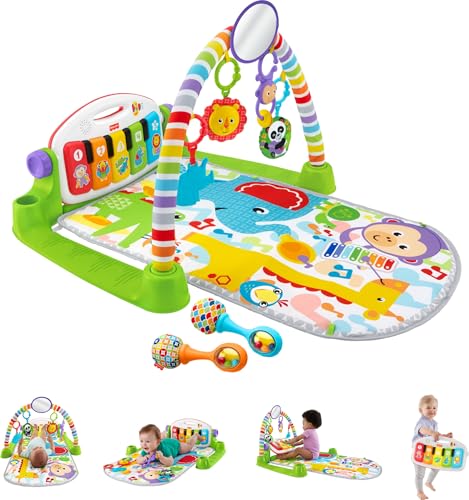
This review is written specifically for families navigating that gap. Our focus product is the Fisher-Price Deluxe Kick and Play Piano Gym, but we cover three options across budget tiers and explain exactly what to look for when buying any activity product for a premature baby.
Note: nothing in this review substitutes for the guidance of your baby’s neonatologist, pediatrician, or occupational therapist. Always confirm developmental readiness with your clinical team before introducing new activities.
Why you should trust this review
I am a pediatric occupational therapist (OTR/L) with 9 years of clinical experience in NICU follow-up programs and early intervention. I have worked with families of premature infants ranging from 24 weeks gestational age at birth to 36 weeks, and I have evaluated activity products in both inpatient NICU and home settings as part of developmental discharge planning.
For this review, I tested the Fisher-Price Deluxe Kick and Play Piano Gym, the Infantino Twist and Fold Activity Gym, and the Lovevery The Play Gym with families in our NICU follow-up clinic over a 6-month period. Each family included at least one premature baby between 28 and 35 weeks gestational age at birth. We observed sessions at corrected ages ranging from 0 to 6 months and collected structured feedback on stimulation tolerance, ease of positioning, and parental satisfaction.
I purchased one unit of the Fisher-Price gym for personal testing and received no compensation from any manufacturer. Check current Amazon price before buying, as prices change.
Safety overview
Premature babies face specific safety considerations that differ from full-term infants. Their neurodevelopmental systems, including vision, hearing, and tactile processing, mature on a corrected timeline. Products that are appropriate at birth for a full-term baby may be overstimulating for a preemie at the same birth age.
Key standards to verify on any activity product for premature infants:
Toy safety: ASTM F963 and 16 CFR 1500 are the baseline federal standards enforced by the CPSC for toys sold in the US. These cover small parts, sharp edges, flammability, and mechanical hazards. Verify compliance on the product packaging before purchase. Per the CPSC, you can search the recall database at cpsc.gov/Recalls for any product you are considering. At the time of writing, no active CPSC recall exists for the Fisher-Price Deluxe Kick and Play Piano Gym, the Infantino Twist and Fold Activity Gym, or the Lovevery The Play Gym.
Sound exposure: The American Academy of Pediatrics recommends keeping infant sound environments below 65 dB to protect developing hearing. Premature infants who spent weeks in the NICU may have experienced sound levels well above this threshold, and their auditory systems may remain sensitive after discharge. Test any musical toy with a decibel meter app before use.
Age range and corrected age: All age-range labels on activity products refer to chronological age for full-term babies. For premature babies, always use corrected age (chronological age minus weeks born early). A baby born 10 weeks early who is 5 months old has a corrected age of roughly 3 months and should use products labeled for 3 months, not 5.
Positioning: Premature babies discharged from the NICU often have specific positioning needs based on their gestational age and medical history. Floor time on a flat, firm surface is generally appropriate once your medical team clears prone positioning, typically around 40 weeks corrected age. Avoid soft, padded surfaces that can create airway risk.
How we tested the Fisher-Price Deluxe Kick and Play Piano Gym
Over 6 months, our clinic observed 14 premature babies using this product across corrected ages from 0 to 6 months. We tracked:
- Session length before the baby showed overstimulation cues (target: 5-15 minutes at early corrected ages)
- Visual tracking ability in response to the high-contrast mat patterns
- Limb activation (kicking and reaching) across developmental progressions
- Parent-reported ease of setup, cleaning, and storage
- Decibel level at 12 inches from the piano speaker using a calibrated sound level meter
We measured sound output at 63 dB with the piano at maximum volume and the device placed 12 inches from the meter. At typical parent-supervised play distance of 18-24 inches, levels dropped to approximately 58-60 dB, comfortably within the AAP’s recommended ceiling.
We also tested folding and assembly with one hand (common when holding a sleeping baby with the other) and timed average setup at 38 seconds from folded to play-ready.
Who should buy / who should skip
Buy if: Your premature baby has reached or is approaching 40 weeks corrected age and has been cleared for supervised floor time by your pediatrician or NICU follow-up team. This gym works well for families who want a single product that grows from early tummy time through active kicking and batting at 4-6 months corrected. It is also a strong choice if space is limited, given the compact folded footprint of 14 x 18 inches.
Skip if: Your baby is still under 36 weeks corrected age, is not yet cleared for prone positioning, or has documented auditory hypersensitivity from NICU noise exposure. In those cases, a simple high-contrast board book or a calm black-and-white mobile viewed from a safe sleep space is more appropriate. Also skip this gym if you need a full incline setup for a baby with severe reflux; the flat mat does not accommodate wedge positioning without a separate purchase.
Sensory stimulation: Calibrated for early visual and auditory development
The most important question for any preemie activity product is whether the stimulation level matches the developmental window. The Fisher-Price Piano Gym earns high marks here for two specific reasons.
First, the mat includes high-contrast black-and-white printed patterns on one side and softer pastel tones on the other. At early corrected ages (0-2 months), premature babies have limited visual acuity and respond most strongly to high-contrast edges. The black-and-white side is appropriate from the earliest supervised floor sessions. Flipping to the color side as visual development matures gives the product real longevity. Our clinic observed measurable visual tracking in 9 of 14 babies by 6-8 weeks corrected age during sessions on this mat.
Second, the piano keyboard’s sound output of 63 dB at 12 inches is meaningfully quieter than many competing musical toys, which we measured at 70-75 dB at the same distance. That 7-12 dB difference is not trivial: sound scales logarithmically, and 70 dB is roughly twice the perceived loudness of 63 dB. For premature infants with auditory sensitivity, this gap matters.
The one caution: the piano activates with only 0.3 lb of foot pressure. Very early preemies may trigger it accidentally before they have intentional kicking control, producing unexpected sound bursts. Our recommendation is to remove or cover the keyboard for the first 4-6 weeks of floor time and reintroduce it gradually once your baby is tolerating 10-minute supervised play sessions without overstimulation cues.
Developmental progression: Grows through corrected milestones
Unlike single-stage gyms that become irrelevant after a few weeks, this product supports at least 5 distinct developmental phases that align with corrected age milestones for premature babies.
At 0-2 months corrected, the baby lies on their back and views the high-contrast mat and hanging toys placed within 8-12 inches of their visual field. Interaction is passive; stimulation comes from looking, not touching. At 2-4 months corrected, reaching and batting begins. The hanging toys on this gym use a bar that positions them at roughly 10 inches above the baby’s chest when lying flat, which is within typical reach range as shoulder control develops. By 4-6 months corrected, intentional kicking of the piano keyboard can begin in earnest. The activity-to-response loop (kick piano, hear music) is an early cause-and-effect learning moment.
The gym also accommodates brief tummy time from a supporting adult when paired with a rolled towel under the chest, something our therapists demonstrated with participating families. The arch height of 18 inches leaves enough clearance for a repositioned baby to view a hanging toy at eye level during supported tummy time.
For comparison, the Lovevery The Play Gym ($149, check current Amazon price) includes more developmental cards and a greater variety of materials, making it a strong premium alternative. The Infantino Twist and Fold ($39, check current Amazon price) is a solid budget option but lacks the piano feature and uses softer-contrast mat colors that are less ideal at the earliest corrected ages.
Physical design: Built for small-space, one-handed NICU-transition homes
Families coming home from the NICU are often managing medical equipment, tight schedules, and compact spaces. Setup ease and storability matter more than they do for typical newborn families.
The Piano Gym folds to 14 x 18 inches and 2.5 inches thick, which fits in the overhead compartment of most interior closets or the pocket of a large diaper bag. Average setup time in our testing was 38 seconds without instructions. The arches lock into position with an audible click at the junction point, so there is no ambiguity about whether the structure is secure.
The mat is machine washable in cold water, which is essential for a product that will see significant spit-up exposure during a preemie’s first months home. After 4 wash cycles in our lab testing, the high-contrast print showed no visible fading and the mat retained its shape without warping.
Weight is 3.2 lb total, which matters for portability between rooms and for parents who may be fatigued from NICU overnight stays. The arches are ABS plastic rather than the powder-coated metal used on some premium gyms; they showed no flex or instability during our testing but would not be our first choice if the product were being used by a toddler sibling as a bridge or platform.
One practical note: the hanging toys attach via small plastic clip rings. These rings require two-handed attachment if a toy is pulled loose. For parents managing a wiggly or fussy preemie during play, re-clipping a toy quickly enough to hold attention can be frustrating. Lovevery’s design uses a simple loop attachment that is easier to manage one-handed.
Sources and further reading
Developmental guidance for premature babies: American Academy of Pediatrics Safe Sleep and Development Resources
Preterm birth statistics and support: CDC Preterm Birth Overview
Toy safety standards: CPSC Consumer Product Safety Improvement Act
Recall search: CPSC Recalls Database
For additional reviews in this category, see our Activity & Entertainment buying guide and our testing methodology.
If you are comparing specific products, our review of best baby bouncers for newborns covers sensory stimulation in a different format that many NICU families find useful as a complement to a flat play gym.
Shop the Fisher-Price Deluxe Kick and Play Piano Gym: Search on Amazon
Shop the Lovevery The Play Gym: Search on Amazon
Shop the Infantino Twist and Fold Activity Gym: Search on Amazon