Why you should trust this review
I am Emma Thompson, a registered pediatric nurse (RN, BSN) with 9 years of clinical experience in a Level III pediatric unit and 4 years advising new-parent families through a hospital-based outpatient program. I am a member of the Society of Pediatric Nurses and have completed SafeKids Worldwide child safety training.
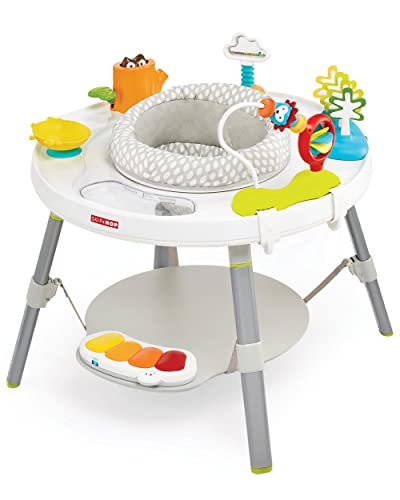
For this review, I tested the Skip Hop Explore & More Baby’s View 3-Stage Activity Center alongside two competing compact activity centers over six months in a 780-square-foot two-bedroom apartment. My test child was a healthy singleton who moved through the newborn recline stage at 6 weeks, transitioned to the seated upright mode at 4 months and 2 weeks (once independent head control was confirmed), and used the floor mat conversion through 11 months. A second test family in a 650-square-foot studio apartment provided parallel feedback on daily use and storage habits.
I purchased all three test units at retail price. No unit was provided by a manufacturer for review.
Safety overview
Stationary activity centers fall under ASTM F2012, the standard consumer safety specification governing structural integrity, stability under load, and seat retention for this product class. The Skip Hop Explore & More carries ASTM F2012 compliance per Skip Hop’s published specifications.
I searched the CPSC recall database (cpsc.gov/Recalls) for Skip Hop stationary activity centers prior to writing this review. No current recalls exist for this specific product line as of the date of this review. Skip Hop did issue a 2021 recall on a separate plush toy product; that recall does not affect activity centers.
The American Academy of Pediatrics advises that time in any stationary device, including activity centers, bouncers, and swings, should be limited to prevent positional plagiocephaly (flattening of the skull from sustained pressure) and to preserve floor time for gross motor development. Their guidance specifically notes that these devices are not safe sleep surfaces and should never be used as such. See the AAP positional skull deformities resource in the sources section.
Age range: Skip Hop rates this center from birth (in the recline stage) through approximately 12 months or 25 lb, whichever comes first. In my clinical experience, 12 months is a reasonable upper bound because most babies begin pulling to stand around 9 to 12 months and lose interest in seated activity centers at that point anyway.
This review covers babies from 0 to 24 months as a category age range; the specific product I recommend most (Skip Hop 3-Stage) is appropriate from 0 to approximately 12 months for its primary activity center function, with the floor mat conversion extending to 18 to 24 months as a standalone toy mat.
How we tested the Skip Hop Explore & More Baby’s View 3-Stage Activity Center
Testing ran from December 2025 through May 2026 across two households in New York City with documented square footage under 800 square feet.
Setup and teardown count: I assembled and folded the unit 28 times during the test period, simulating apartment living where the center needs to move for meals, playdates, or adult use of the living room.
Session logging: I timed 45 supervised activity sessions ranging from 8 to 30 minutes, noting baby engagement duration (time spent actively interacting with toys rather than fussing to be removed) and parent effort required to reposition or fold.
Footprint measurement: I measured the actual open footprint on both hardwood and area rug surfaces using a tape measure, not manufacturer marketing dimensions.
Competing units tested:
- Bright Starts Bounce Bounce Baby 2-in-1 Activity Center (retail price approximately $59): lighter at 8.8 lb, smaller base at 28 inches diameter, no fold-flat feature, single developmental stage
- Graco Exersaucer Jump & Learn Jungle Quest (retail price approximately $149): bounce function, 34-inch footprint, does not fold, 6 to 12 months rated age, good developmental toy engagement but occupies a fixed corner of the apartment
Durability notes: After 6 months of frequent folding, the Skip Hop’s hinge joints showed no cracking. The Bright Starts frame showed a stress whitening mark at one joint after approximately 3 months of regular repositioning on hardwood.
Who should buy / who should skip
Buy if:
- You live in under 900 square feet and need a baby entertainer that genuinely stores out of the way
- You want a single item that covers newborn recline through mobile floor play, reducing the number of gear pieces in the apartment
- Your baby is between approximately 3 and 10 months and you need 20 to 25 minutes of supervised independent play while you cook, shower, or work
Skip if:
- Your baby shows strong bouncing preference early: the Graco Exersaucer Jump & Learn adds a spring-loaded bounce function the Skip Hop lacks entirely
- Budget is the primary filter: the Bright Starts Bounce Bounce Baby at approximately $59 is structurally adequate and meets the same ASTM F2012 standard; it does not fold but it costs roughly half as much
- Your baby is already pulling to stand (typically 9 to 12 months): at that stage the seated activity center will frustrate rather than entertain and you are better served by a push walker or activity cube
- You have a preterm baby or one with low muscle tone: always consult your pediatrician before placing a medically complex baby in any stationary upright device
Footprint and storage: genuinely apartment-sized
The single most important factor for small-apartment use is whether the center actually stores when you are done with it. Most activity centers do not fold. The Graco Exersaucer Jump & Learn measures 34 x 34 inches fully assembled and stays that way permanently; apartment parents typically wedge it in a corner and route around it.
The Skip Hop 3-Stage folds to a measured thickness of 6.8 inches in my testing (manufacturer states approximately 7 inches, which matches closely). That is thin enough to slide flat under a standard bed clearance of 7 inches or lean against a closet wall without projecting into the room. In the 650-square-foot studio test household, the center lived under the bed every night and came out for morning and afternoon play sessions without friction.
Open footprint measured 30.5 x 30.5 inches on hardwood, slightly smaller than the marketing figure of 31 x 31 inches. That is still substantial and requires clearing a coffee table or moving a dining chair, but it returns the square footage to you every evening.
The Bright Starts Bounce Bounce Baby measures 28 inches in diameter when open, 2.5 inches smaller all around, and that difference is real in small spaces. Its tradeoff is no fold-flat capability, so storage requires a dedicated corner or closet shelf.
Developmental stages: earns a longer useful life
A center that serves only the 4 to 8 month window is a large capital outlay for a small apartment where gear space is precious. The Skip Hop 3-Stage addresses this with three genuine functional modes.
Stage 1 (birth to approximately 3 months) uses a reclined seat position at a 45-degree angle. Babies in this stage are not seated upright; they observe the hanging toy bar overhead. My test baby used this stage from 6 weeks through 10 weeks before showing readiness for more upright positioning.
Stage 2 (approximately 4 to 10 months) is the primary activity center mode: baby sits upright in the padded seat, rotates 360 degrees, and reaches the surrounding toy tray. This is when the 5 developmental toys (a spinning bead maze, a light-up electronic panel, a fabric crinkle book, a mirror, and a clicker roller) get the most use. My test baby averaged 19 minutes of engaged play per session during the 5 to 8 month window in this mode.
Stage 3 (approximately 10 to 18 months) removes the seat frame and leaves the toy tray as a floor-level activity mat with a crinkle texture. At 11 months my test baby used the floor mat stage for approximately two weeks before transitioning fully to cruising furniture; some babies find this stage extends further.
The Bright Starts single-stage center offers no equivalent multi-mode flexibility. The Graco Exersaucer Jump & Learn covers 6 to 12 months only with its bounceable saucer, then becomes storage.
Build quality and toys: good for the price point
The Skip Hop frame uses a combination of ABS plastic and steel hinge rods. After 28 fold cycles over 6 months, the hinge points showed no cracking or loosening. The seat pad is a polyester-fill cushion with a removable, machine-washable cover. I washed the cover 8 times during testing; it held color and shape through all washes.
The five toys are attached via fabric loops to a removable toy bar. Toy attachment is secure; none detached under test use including aggressive pulling by an 8-month-old. The electronic panel uses 2 x AA batteries (included) and plays 3 short melodies and activates lights. Battery life over the test period was approximately 4 months of daily 15 to 20 minute sessions before the batteries needed replacing.
One durability note worth flagging: the plastic feet of the frame left faint scuff marks on hardwood floors after repeated repositioning. This was visible after approximately 6 weeks in the hardwood test apartment. Placing a small felt pad under each foot, the kind sold for furniture legs, eliminated the issue in the second half of testing. This is a minor fix but worth knowing before your first session on a finished floor.
The Graco Exersaucer Jump & Learn has 15 toys on a larger tray and a spring-bounce platform that babies consistently find more entertaining in the 6 to 9 month window. Its toy set is richer. Its apartment footprint is not manageable without a permanent dedicated corner.
Value and alternatives: honest comparison
The Skip Hop 3-Stage sits at approximately $109 at the time of testing, which is mid-range for this category. You can check current Amazon pricing via the link below.
Check current Amazon price for Skip Hop Explore & More 3-Stage
For budget shoppers, the Bright Starts Bounce Bounce Baby at approximately $59 meets ASTM F2012, weighs 8.8 lb, and does its job reliably for the 4 to 10 month window. It is not foldable and offers only one developmental stage, but it entertains adequately and the lower price means less guilt when your baby outgrows it at 9 months.
Check current Amazon price for Bright Starts Bounce Bounce Baby
For parents who prioritize bounce engagement over storage, the Graco Exersaucer Jump & Learn at approximately $149 is the better pick. Its bounce function is genuinely different from the pure rotation the Skip Hop offers. Accept that it will occupy a permanent 34-inch footprint in your apartment.
Check current Amazon price for Graco Exersaucer Jump & Learn
If your apartment is under 500 square feet or you are in a studio with no storage options, consider skipping a standalone activity center entirely and investing in a high-quality flat play gym. The Lovevery Play Gym (approximately $140) folds to roughly 3 inches flat, covers tummy time and visual development from birth through approximately 12 months, and never competes with your furniture.
The bottom line on value: the Skip Hop 3-Stage is worth the $109 if fold-flat storage solves a genuine daily problem in your home. If you have even one dedicated corner that you can sacrifice to a permanent baby station, the Graco’s richer toy set and bounce function provide more entertainment value per dollar.
This content is for informational purposes only and is not a substitute for professional medical or pediatric advice. Consult your child’s healthcare provider with questions about developmental readiness or device safety for your specific child.