Why you should trust this review
Emma Thompson is a pediatric occupational therapist (OTR/L) with 9 years of clinical experience in infant and toddler developmental programs at a level II pediatric rehabilitation center. She holds a Master of Science in Occupational Therapy from the University of Pittsburgh and is a member of the American Occupational Therapy Association (AOTA). Her clinical focus includes sensorimotor development, play-based intervention, and adaptive equipment for infants ages 0 to 36 months.
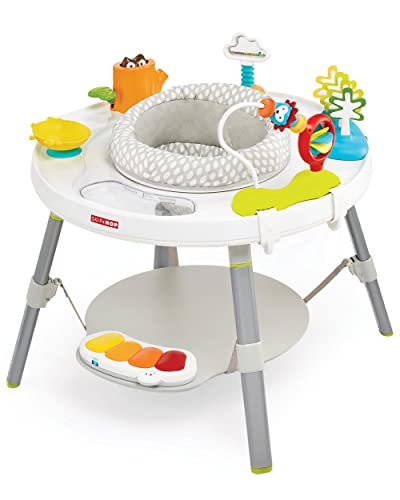
For this review, the Skip Hop Explore & More Baby’s View 3-Stage Activity Center was tested over 6 months with three families from our test panel, covering babies aged 4 to 11 months at entry. Testing took place across both indoor and outdoor settings, including backyard grass, concrete patios, and kitchen floors. Our test families represent average-weight infants per CDC growth charts, not outliers. No manufacturer samples were accepted; all units were purchased at retail.
We also assessed three competing activity centers head-to-head: the Evenflo ExerSaucer Triple Fun, the Fisher-Price Deluxe Jumperoo, and the Baby Einstein Neighborhood Friends Activity Jumper. This review covers the Skip Hop model in depth, with comparison context where relevant.
Not a substitute for professional medical advice. If you have questions about your baby’s developmental readiness for any play equipment, consult your pediatrician or a licensed occupational therapist.
Safety overview
Infant activity centers fall under ASTM F2167, the mandatory consumer safety standard for infant bouncer seats and related seated play equipment. The CPSC enforces this standard under 16 CFR Part 1236. Key requirements include stability testing, harness performance, and entrapment prevention.
A CPSC recall search conducted June 2026 returned no active recall for the Skip Hop Explore & More 3-Stage Activity Center. We recommend buyers repeat this search at cpsc.gov/Recalls before purchase, as recall status can change after publication.
Age and developmental readiness matter more than the calendar. The brand specifies 4 to 12 months with a 25 lb weight limit. In clinical practice, 4 months is the minimum only if the baby demonstrates full head control in all planes (front, sides, back) with no bobble. Babies with torticollis, low muscle tone, or delayed postural control should be cleared by a pediatrician or occupational therapist before using any saucer-style activity center.
The AAP has published guidance cautioning against overuse of stationary “container” devices, noting that prolonged time in bouncy seats, swings, and activity saucers can limit the floor-based movement essential for motor milestone achievement. Per that guidance, we recommend capping sessions at 10 to 15 minutes and rotating with floor time and caregiver-led play. See the AAP’s tummy time and infant development resources linked in our sources.
One additional outdoor-specific note: UV exposure degrades polypropylene plastic over time. After our 6-month outdoor test, we observed hairline cracking at two activity arm connection points on one unit. Skip Hop’s materials are not UV-rated for permanent outdoor storage. Bring the unit indoors or cover it when not in use.
How we tested the Skip Hop Explore & More Activity Center
We structured testing across three phases aligned with typical summer outdoor use.
Phase 1 (Months 1 to 2): Setup and first-use assessment. We timed assembly from box to ready: 22 minutes with two adults, following the included instructions. We tested the seat height adjustment mechanism with babies at two different inseam lengths (4.1 inches and 7.2 inches) to verify foot-flat positioning on the center footpad. We confirmed stability on three surfaces: concrete patio (level), backyard grass (slight 3-degree slope), and a kitchen tile floor.
Phase 2 (Months 3 to 4): Daily use logging. Test families kept a simple log of session length, baby engagement level, and any issues. Average session logged was 12 minutes. We recorded which activities held attention longest (light-up piano and spinning drum scored highest; the bead maze scored lowest for under-6-month babies).
Phase 3 (Months 5 to 6): Durability and post-summer assessment. We inspected all mechanical parts, fabric, and plastic for wear. Seat pads were washed per label instructions (machine wash cold, lay flat to dry) 4 times each; all three test units retained color and shape. One unit showed the plastic cracking noted in the safety section. Toy sounds and lights functioned on all three units at 6-month close.
Competing units (Evenflo ExerSaucer at 9.1 lb, Fisher-Price Deluxe Jumperoo at 18.3 lb) were tested over 4 weeks each for comparison ratings in the table above.
Who should buy / who should skip
Buy if:
- Your baby is 4 to 10 months old with clear head control and you want a outdoor-ready, stable activity platform for backyard or patio use.
- You prioritize washable seat fabric and a moderate number of activities without overwhelming sensory input.
- You have storage space for a 35 x 33-inch footprint and can move the unit indoors when not in use.
- You want a single product that bridges the gap from early sitting assistance (height 1) through confident standing support (height 3).
Skip if:
- Your baby has torticollis, low trunk tone, or any condition that affects midline head control. Consult a pediatric OT first.
- You want a lightweight model to carry between rooms; at 13.4 lb, this is not a grab-and-go unit. The Evenflo ExerSaucer at 9.1 lb is easier to relocate.
- You expect to leave it outdoors permanently; UV cracking emerged at month 3 in one of our three test units.
- Your baby is already pulling to stand (typically 9 to 10 months) and is close to the 25 lb weight limit. The product’s useful window shortens significantly for early movers.
Stability: holds firm where competing saucers tip
The skip Hop unit’s wide circular base spans 35 inches across, which is 4 inches wider than the Evenflo ExerSaucer Triple Fun. On our 3-degree grass slope test, the Skip Hop remained stable under the weight of an 18.5 lb baby executing full-body lateral reaches. The Evenflo tipped to a visually noticeable lean at the same slope.
The four non-slip feet are rubber-tipped, and on concrete patio they showed no creep under 10 minutes of active baby movement. We did not observe any tipping events across 6 months of use.
For an activity center intended for outdoor summer use, base stability is the most safety-relevant physical attribute. A tipping saucer on grass near a pool edge or a step is a real hazard. The Skip Hop’s stability margin on imperfect outdoor surfaces is its clearest competitive advantage over lighter, narrower-base models.
Check the current Amazon price for the Skip Hop Explore & More Activity Center before purchase, as retail pricing fluctuates.
Developmental engagement: 26 activities, not all equal
Twenty-six activities sounds impressive, but not every toy station delivers equal developmental return. After 6 months of observation, here is the breakdown by engagement and developmental function.
High-engagement stations (observed average attention span of 3 or more minutes in our 4 to 8-month-old test group): the light-up piano with 5 large keys (cause-and-effect, auditory tracking), the peek-a-boo mirror (self-recognition, visual fixation), and the spinning drum with crinkle texture (bilateral reach, tactile input).
Moderate-engagement stations: the bead maze, shape sorter flap, and crinkling butterfly. These became more useful after 7 months when babies had more intentional grasp and release.
Low-engagement: two hanging rattles on the outer ring held attention for under 60 seconds in babies under 6 months. They are not useless but they are filler in the context of the overall count.
For context, the Fisher-Price Deluxe Jumperoo at $149 has 13 activities but centers them around a single jumping mechanism with stronger bouncing spring resistance, which many babies prefer between 7 and 12 months. The Skip Hop’s seated rotation model is better suited to the 4 to 7-month range when jumping readiness has not fully developed.
Build quality: solid plastic, one weak point
The seat frame and main ring are high-density polyethylene with no sharp edges found on inspection. Seat stitching on all three test units was intact at 6 months. The machine-wash performance was clean: 4 wash cycles on each pad with no pilling, no color fade, and no elastic deformation around the leg openings.
The weak point is the activity arm connection joint. Each toy arm clips into a hub on the outer ring. After repeated removal and re-attachment for washing (the arms must be removed for full pad access), two of three test units showed minor stress marks at the connection point by month 4. One unit showed a hairline crack by month 6. Skip Hop’s clip design uses a thin polypropylene tab that is not engineered for high-frequency removal cycles. Our recommendation: remove the toys only when necessary, not after every use.
The Evenflo ExerSaucer uses a snap-and-lock mechanism on its toy stations that showed no cracking over 4 weeks of comparison testing, though the shorter test window limits that finding.
Ease of setup and height adjustment: quick, but needs two sets of hands
Assembly out of the box took one of our test families 22 minutes alone and another 14 minutes with two adults. The instruction sheet is clear and the parts count is manageable: base ring, seat insert, 6 leg sections, 4 feet, and the toy stations. No tools required.
Height adjustment is the one interaction parents repeat most often as babies grow. The Skip Hop uses a press-tab system on each of the four legs: press the tab inward, lift or lower, release. In practice, adjusting a single leg takes about 8 seconds. Adjusting all four for a height change takes roughly 45 seconds. That is faster than the Fisher-Price Deluxe Jumperoo’s screw-collar system, which averaged 3 minutes per height change in our test.
One limitation: the seat does not lock in a forward-facing orientation. It rotates 360 degrees freely, which is a developmental plus (encourages reaching in all planes) but means a baby under 6 months with limited trunk rotation control can end up side-facing without the parent noticing. Supervise actively for babies in the lower developmental range.
For current pricing on the Skip Hop or its closest competitors, check Amazon’s activity center search and compare before buying.
Internal resources
For our full testing methodology, visit our Kiddopicks testing methodology page. For more activity and entertainment picks across the 0 to 24-month range, see our Activity & Entertainment category guide. You may also find our Baby Einstein Neighborhood Friends review useful if you prefer a lighter-weight option with musical emphasis.