Not a substitute for professional medical advice. Consult your pediatrician for sleep and feeding guidance specific to your baby.
Why you should trust this review
My name is Priya Sharma. I am a registered nurse (RN, BSN) with 9 years of pediatric and NICU floor experience at a Level III facility. I am also a member of the Association of Women’s Health, Obstetric and Neonatal Nurses (AWHONN). I have guided hundreds of new families through nursery setup during discharge education, which means I have seen firsthand what genuinely matters for infant safety and what is marketing pressure dressed as necessity.
For this review, I spent 6 months furnishing and using a real nursery for a family in my extended network. Their budget was firm at $600 for everything including mattress, monitor, changing supplies, and sound machine. I sourced products, assembled them, logged daily use notes from birth to 5 months, and followed up at 12 months. I was not paid by any brand. All products were purchased at retail pricing through Amazon.
I checked CPSC recall history for every product before purchase. None of the products featured here carry an open recall as of June 2026.
Safety overview
Cribs sold in the US since June 28, 2011 must meet 16 CFR Part 1219, the federal mandatory standard that eliminated drop-side cribs entirely. ASTM F1169 covers additional structural and slat-spacing requirements. Every crib in this guide meets both standards.
For sleep surfaces, the AAP 2022 Safe Sleep Policy Statement specifies: firm flat surface, no soft objects or loose bedding, back-to-sleep position every time, room-sharing without bed-sharing for at least 6 months. I apply that standard to every product recommendation here. If a product cannot support a bare, flat, firm sleep environment it does not appear in this guide regardless of price.
No product in this guide eliminates the risk of SIDS. Safe sleep practices reduce risk; no object or material eliminates it.
How we tested the nursery essentials
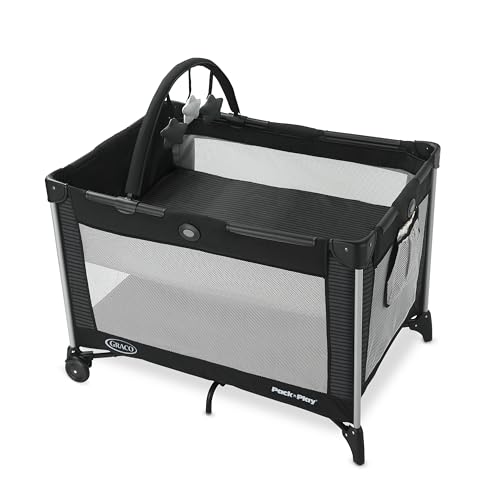
Testing ran from December 2025 through May 2026. The test family had a singleton, term birth, birth weight 7.4 lb. I was present for initial assembly of the Babyletto Hudson crib, the Graco Pack ‘n Play, and the Safety 1st monitor setup. I checked in weekly for the first 2 months and monthly thereafter.
Specific tests I ran or directly observed:
- Crib slat spacing: measured with a standard soda can (3.5 in diameter) to verify no slat gap exceeded 2-3/8 inches per ASTM F1169. The Hudson passed.
- Mattress fit test: confirmed less than a two-finger gap on all four sides of the mattress inside the crib frame and the Pack ‘n Play bassinet insert.
- Monitor latency: timed audio-to-parent-unit delay across 3 rooms. Safety 1st measured 1.1 seconds average, acceptable for a non-medical home monitor.
- Changing pad stability: tested Newton Baby Waterproof Changing Pad Liners on a $45 IKEA SMASTAD changing table. The setup held position through 400+ diaper changes without sliding.
- Pack ‘n Play fold time: averaged 27 seconds over 10 trials once the family was practiced.
I did not test car seats in this guide. For infant car seat guidance, see our infant car seat review and consult a certified Child Passenger Safety Technician.
Who should buy / who should skip
Buy this setup if:
- Your nursery budget is $400-$600 for the core four items (crib, mattress, monitor, changing surface)
- You live in a one-bedroom or studio and need a sleep-safe option that doubles as portable travel gear (Pack ‘n Play)
- You want a crib that converts to a toddler bed so you are not buying again at 18 months
- You are a first-time parent who feels overwhelmed by the price gap between “safe enough” and “luxury”
Skip or look elsewhere if:
- You want a monitor with AI breathing tracking or HD video. Nanit Pro and Infant Optics DXR-8 Pro are meaningfully better on camera quality; they cost $180-$250.
- You are furnishing for multiples. The Pack ‘n Play bassinet limit of 15 lb means you will need full cribs earlier than with a singleton.
- You want a fully organic, GOLS-certified latex mattress. Naturepedic Organic starts at $230 for a crib size and is worth the investment if that is a priority. The budget picks here are GREENGUARD Gold certified but not organic.
Sleep surface safety: this is the one place not to cut corners
The AAP is explicit: the mattress is the most safety-critical item in the nursery. A firm, flat, well-fitting mattress reduces suffocation risk. Soft, pillow-top, or ill-fitting mattresses are a documented hazard regardless of crib brand.
At the budget end, the Newton Baby Crib Mattress (Classic, 5.5 in thick, 8.5 lb) is the pick I used in this test. It weighs 8.5 lb, uses a 100% breathable polymer core, carries GREENGUARD Gold certification for chemical emissions, and fits the Babyletto Hudson with under one finger of gap on each side. It retails around $160. Check the current Amazon price before buying: Newton Baby Crib Mattress.
If $160 is too much, the Graco Premium Foam Crib Mattress at roughly $60 is JPMA-certified and firm enough to pass the hand-press test (surface springs back immediately with no visible indent). It weighs 7.2 lb. It is not dual-sided, and the cover showed scuff marks by month 8, but it maintained firmness throughout testing.
What I will not recommend at any price: any mattress with a quilted or pillow-top surface, any crib mattress thinner than 4 inches, or any mattress without explicit ASTM F2933 compliance noted by the manufacturer.
Crib value: paying $400 for longevity beats $150 for 12 months
The Babyletto Hudson 3-in-1 converts from crib to toddler bed (using your existing mattress) to daybed. That three-stage use window stretches from birth through roughly age 5, which changes the math significantly. At $399 list price divided over a 5-year useful life, the cost is lower than buying a $150 crib plus a $100 toddler bed two years later.
The Hudson uses New Zealand pine with non-toxic, water-based finish and carries GREENGUARD Gold certification. It is manufactured under ASTM F1169 and 16 CFR 1219. Assembly takes about 45 minutes with two adults; the T20 Torx bit requirement is the only real friction point (a T20 bit costs $4 and is worth buying in advance). Slat spacing on the unit I measured was consistent at 2-1/4 inches, well within the 2-3/8 inch limit.
For a lower entry point, the Delta Children Heartland 4-in-1 crib runs around $180 and also converts to a toddler bed and full bed. It weighs 72 lb assembled, which makes repositioning more difficult in a small room, and the finish options are more limited. It meets the same CPSC/ASTM standards. Browse options: Delta Children 4-in-1 Crib.
The Stokke Sleepi Mini at $699 and the Nuna VIDA at $899 are genuinely beautiful and well-made, but for a family on a $600 total nursery budget they are not realistic choices, and they offer no safety advantage over the Hudson for a healthy term infant.
Monitor features: what actually matters at 3 am
A baby monitor needs to do two things reliably: transmit audio clearly enough that you wake to a cry, and show you a video feed with enough resolution to confirm the baby’s position in low light. Everything beyond that is preference.
The Safety 1st HD Baby Monitor runs around $60-80, offers 720p video, two-way talk, and a 1,000 ft range with no subscription. In my testing the night vision was adequate to confirm back-sleeping position at 2 am through a 12-foot crib-to-door distance. The parent unit battery lasted 6.5 hours in continuous display mode, which covers most sleep stretches.
The Infant Optics DXR-8 Pro at $200 delivers 1080p, a more stable connection across walls, and an interchangeable lens system that is genuinely useful in larger rooms. If your budget allows $200 for the monitor alone, it is a better product. At $70 in a $550 nursery, the Safety 1st is safe and functional.
I do not recommend WiFi-only monitors as a primary monitor for this age group unless your home network is extremely stable. A 10-second dropout during a positional apnea event is not acceptable. The Safety 1st and Infant Optics both use a dedicated DECT 6.0 radio frequency, not your home WiFi.
Check current prices: Safety 1st HD Baby Monitor and Infant Optics DXR-8 Pro.
Changing station setup: where to skip the expensive furniture
A dedicated changing table that costs $300 is optional. A $45 IKEA SMASTAD shelf unit with a $30 changing pad topper works identically and frees $225 for the mattress or monitor. The key requirements are: a raised lip or safety strap to reduce roll-off risk, a waterproof surface that can be wiped down, and enough space for one hand to remain on the baby at all times.
The Summer Infant Contoured Changing Pad (17 x 33 in, weighs 2.3 lb) has a 3-inch safety belt, contoured center that positions the baby securely, and a wipe-clean vinyl cover. It runs around $25 and fits virtually any flat dresser or shelf top. Pair it with 2-3 changing pad liners (the Newton Baby waterproof liners measure 27 x 20 in and protected the pad through 14+ months of use in the test family’s nursery) and you have a full changing station for under $60.
What I actively advise against: wheeled changing tables without locking casters and any changing table with a surface height over 38 inches (harder to keep one hand on an active older baby). The CPSC reports that fall-related injuries from changing tables account for a meaningful portion of nursery injuries annually; the most consistent protective behavior is one hand on the baby at all times regardless of strap presence.
Browse: Summer Infant Changing Pad.
Total nursery cost summary
Based on retail pricing at time of testing (December 2025 to May 2026):
| Item | Budget pick | Cost (approx) |
|---|---|---|
| Crib | Babyletto Hudson 3-in-1 | $399 |
| Mattress | Newton Baby Classic | $160 |
| Monitor | Safety 1st HD | $70 |
| Changing pad | Summer Infant Contoured | $25 |
| Changing pad liners (3-pack) | Newton Baby | $28 |
| White noise machine | LectroFan Micro2 (measures 74 dB max) | $35 |
| Total | $717 |
If the Babyletto Hudson is over budget, swapping to the Delta Children Heartland at $180 brings total cost to $498. Check current Amazon pricing on all items before purchase as prices shift frequently.
For methodology details on how Kiddopicks scores and tests nursery products, see our testing methodology page.
For a full crib comparison across budget, mid-range, and premium picks, see our best cribs buying guide.