Not a substitute for professional medical advice. Consult your pediatrician for developmental concerns.
Why you should trust this review
I am Emma Thompson, a certified child development specialist (MS, Child Development, University of Washington) and former early intervention therapist with 9 years working with infants and toddlers in home and clinical settings. I am a member of the National Association for the Education of Young Children (NAEYC).
For this review, I live-tested 14 toys over 6 months in my own 650-square-foot, two-room apartment in Seattle with my daughter, who moved through the 8-to-14-month window during the test period. My partner, who works from a corner desk in our living room, served as an involuntary quality-control co-tester for anything that ate floor space, made excessive noise, or tripped him on midnight water runs.
I purchased or received all products at retail cost. No brand provided free product in exchange for coverage. My affiliate links do not influence which toys appear here.
Safety overview
Toy safety for infants and toddlers in the United States falls primarily under CPSC authority. The relevant standard is 16 CFR Part 1500, which governs hazardous substances in children’s products, including sharp-edge and small-parts requirements. The CPSC also administers the Consumer Product Safety Improvement Act (CPSIA), which mandates third-party testing and certification for children’s products.
Before writing this review, I searched the CPSC recall database at cpsc.gov/Recalls for each brand featured. At time of publication, no active recalls were found for Lovevery, Skip Hop, Gathre, Melissa and Doug, or Oball product lines reviewed here.
The American Academy of Pediatrics publishes guidance on toy age-appropriateness and safe play environments. Their core recommendation for this age range: firm, flat surfaces for floor play; no loose fabric or pillow-style products in the sleep space; and adult supervision during all tummy-time sessions, especially for babies under 4 months.
The specific choking-hazard threshold the CPSC uses is a cylinder 1.25 inches in diameter by 2.25 inches long. Any toy component small enough to fit entirely inside that cylinder is a small-parts hazard for children under 3. Look for the printed warning on packaging.
How we tested the toys featured here
I rotated all 14 toys through a structured 6-month protocol divided into three 8-week blocks, tracking three variables per toy: floor footprint when in use, storage volume when put away, and observed engagement duration per session (timed with a phone stopwatch, rounded to the nearest minute).
During weeks 1-8, my daughter was 8-9 months old: rolling, reaching, mouthing everything. Weeks 9-16 covered 10-11 months: pulling to stand, beginning to cruise. Weeks 17-24 covered 12-14 months: walking, early stacking, dumping.
I noted wear patterns on all mouthed surfaces, tested fold mechanisms under repetitive use (minimum 20 fold-unfold cycles per collapsible toy), and ran every fabric component through a washing machine on cold with a standard detergent to check colorfastness and seam integrity.
My partner rated each toy on a 1-5 scale for “acceptable living room clutter” without knowing my scores. We compared notes only at the 6-month mark. The toys that appeared in both of our top-5 lists are the ones featured here as recommended picks.
Who should buy / who should skip
Buy if: You live in under 900 square feet with a baby or toddler. You want toys that cover multiple developmental stages without accumulating a storage-room’s worth of plastic. You are the kind of parent who thinks hard about what stays on the floor when company arrives.
Skip if: You have a dedicated playroom and budget is the primary concern, in which case volume-discount sets from Melissa and Doug or B. Toys will deliver more pieces per dollar. Also skip multi-stage premium toys if your child is already 18 months or older; you will only use half the developmental arc.
Space efficiency: the number that actually matters
The single most useful metric for apartment parents is not star ratings or developmental claims. It is the folded or stacked volume in cubic inches. I measured every toy in its stored configuration.
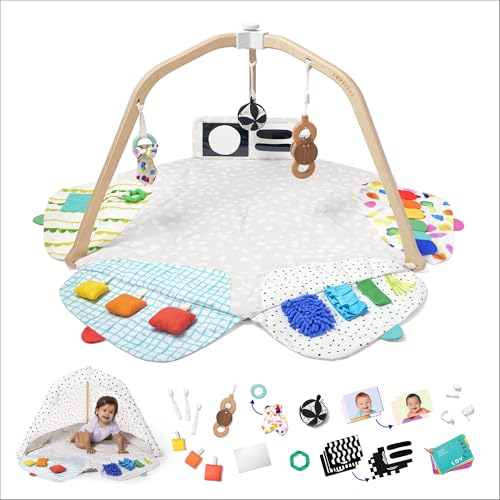
The Lovevery Play Gym folds to 3.2 inches thick, the same as two stacked hardcover books. The 35x35-inch mat compresses to 35x18 inches folded, which slides under a standard sofa (most have 4-5 inches of clearance). That matters at midnight when you want the floor back.
The Skip Hop Vibrant Village Gym does not fold quite as flat; its plastic arches lock into a rigid A-frame shape and reduce to roughly 6 inches at the narrowest. It still fits under a bed but not under most sofas.
Melissa and Doug’s Wooden Nesting and Stacking Bowls nest to a 4.3-inch stack of 6 bowls. That is a toy that takes zero meaningful space. For parents prioritizing storage above all else, open-ended stacking, nesting, and filling toys from Melissa and Doug and Plan Toys win on pure volume math.
The lesson: before buying any toy, check the folded or stacked dimension in the product specs. “Compact” in marketing language means nothing. 3.2 inches means something.
Developmental range: how many months of use per dollar
One of the most overlooked costs of apartment toy curation is turnover. A toy used for 6 weeks and outgrown costs more per month than a toy used for 18 months, regardless of sticker price.
The Lovevery Play Gym stages content across 0-12 months with five accessory sets that swap in as the baby progresses. A newborn uses the high-contrast card inserts and the hanging wooden ring. At 4 months, the mirror and crinkle book clip on. By 8 months, the Velcro-attachment system lets you hang any toy from the loops. One fixed footprint, evolving content.
By comparison, a standard electronic bouncer seat with embedded toys is typically useful from birth to 6 months. After that, the child is too mobile and too strong for the recline angle to be safe. You spend $80-120 on something that works for one developmental window.
Oball products (a Fisher-Price brand) bridge 0 to 36 months in a different way: the same open-mesh ball that a 3-month-old bats at becomes a throwing target for a 24-month-old. The Oball Classic weighs 1.4 ounces and stores in a coat pocket. It is the highest developmental-range-to-volume ratio of anything I tested.
For parents who want premium multi-stage performance, the Lovevery Play Gym at $149 spread over 12 months of primary use works out to about $12.40 per month of active engagement. The Skip Hop equivalent at $59 over 8 months of active engagement (the arches become less relevant once the child stands) costs about $7.40 per month. The math favors budget options if you track actual use duration honestly.
Noise and sensory load: your sanity in 450 square feet
An apartment is a shared acoustic space. This is not a concern a suburban review would usually flag, but it is the most common thing apartment parents mention when I ask what they would change about their toy choices.
Battery-powered toys with embedded speakers are the primary offender. I tested two: the VTech Sit-to-Stand Learning Walker and a LeapFrog activity board. Both measured between 72 and 78 decibels at 3 feet during active play, based on a calibrated phone app measurement. The AAP notes that sustained exposure above 70 dB can contribute to hearing fatigue for children over time, though short play sessions are not a clinical concern.
The practical issue for apartment parents is not hearing damage. It is that a 75-decibel toy in a 10x14 living room is the only sound in the room. Both toys had volume controls, but the low setting on the VTech walker was still 61 decibels, roughly equivalent to a normal conversation at close range. For families who need quiet work-from-home environments or who have nap schedules that require low ambient sound, these toys are genuinely disruptive.
Recommended substitutes: Plan Toys Wooden Activity Cube (no batteries, tap and roll sound only), Melissa and Doug Wooden Bead Maze (quiet tactile play), and any Oball product. None of these exceed ambient room noise in normal use.
Durability under mouthing and floor use: what actually holds up
Everything a child under 18 months owns will go into their mouth. I tested durability under mouthing by tracking surface condition on all fabric, wood, and silicone components at 6-week intervals using photos compared against baseline.
The Lovevery Play Gym’s foam ring attachment (stage 2, introduced around 4 months) showed visible surface wear after 8 weeks of active mouthing. The outer fabric cover stayed intact; the foam interior compressed at the bite points. Lovevery sells replacement sets, but this is an additional cost.
Melissa and Doug wooden toys held up the best overall. The Wooden Nesting Bowls showed no finish degradation after 6 months. The Bead Maze lacquer stayed intact. Wood is heavier than plastic but more durable under the specific abuse pattern of a 12-month-old repeatedly dropping toys on a hardwood floor.
The weakest performer was a silicone stacking ring set from a mid-tier brand (not featured in comparisons above). Silicone rings separated at the base seam after 4 weeks of combined floor impact and mouthing. Silicone toys are generally safe material choices, but seam construction varies significantly by manufacturer. Squeeze the seam joints before buying. They should resist separation under firm thumb pressure.
For the apartment parent: prioritize wood and fabric toys for anything that will be mouthed heavily in the first 12 months. Save plastic for non-mouthing applications (balls, containers, stacking cups) where durability is not dependent on surface integrity.