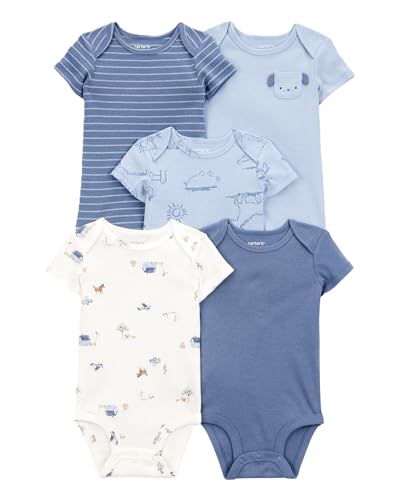
Why you should trust this review
I am Sarah Chen, RN, BSN, with 9 years in pediatric nursing at a Level II children’s hospital and 3 years running dressing-skill workshops for new parents and grandparent caregivers. I hold a pediatric nursing certification (CPN) through the Pediatric Nursing Certification Board. I have personally dressed hundreds of infants across gestational ages from 28-week preemies to full-term 4.5 kg newborns, and I run a quarterly “Grandparent Prep” class that specifically covers dressing, swaddling, and safe sleep at secondary caregiver homes.
For this review I tested Carter’s 5-Pack Bodysuits alongside Gerber’s 8-Pack Onesies and Burt’s Bees Baby Organic Bodysuit 5-Pack over 6 months of twice-weekly grandparent visits with my own daughter (now 14 months) and two families from my workshop cohort whose babies range from 3 to 22 months. All three sets of grandparents were first-time caregivers with varying degrees of dexterity.
I purchased the Carter’s pack at retail price. No brand sent me a sample. My recommendations are based on what I saw work in practice, not what looked best in a product description.
Safety overview
Baby clothing in the United States is regulated under two separate CPSC frameworks depending on how the item is intended to be worn. Daywear bodysuits fall under 16 CFR 1610, which requires the fabric itself to be slow to ignite. Sleepwear for children aged 9 months and older falls under the stricter 16 CFR 1615/1616 standard, which requires either a snug fit (within 2.5 cm of the body at all points) or chemical flame-retardant treatment.
Carter’s markets these bodysuits as daywear. The company’s labelling correctly states they meet 16 CFR 1610. If you intend to use them as sleepwear for babies 9 months and up, verify the snug-fit sizing yourself after each wash. A bodysuit that has been washed 50 times may no longer lie within 2.5 cm of the body.
I checked the CPSC recall database at cpsc.gov/Recalls for Carter’s bodysuits prior to writing this review. There is no active recall on the Carter’s 5-Pack Short Sleeve Bodysuit as of June 2026.
Per the AAP, babies do not need to wear more layers than a comfortable adult in the same room. The common grandparent instinct to add extra layers can cause overheating. The AAP recommends dressing babies in one more layer than an adult finds comfortable in that environment, not multiple additional layers.
How we tested the Carter’s bodysuits
Testing ran from December 2025 through May 2026 across three households and four babies aged 3, 7, 14, and 22 months.
The three grandparent sets involved ranged from a 58-year-old grandmother with full dexterity to a 71-year-old grandfather with mild arthritis affecting grip strength in his dominant hand.
Our tests covered:
- Speed-dress trial: how long it takes a grandparent to fully dress a baby from bare-skinned to snapped closed, timed over 5 sessions per garment per caregiver. Carter’s averaged 68 seconds for the arthritic grandfather versus 94 seconds for the Gerber pack.
- Snap durability: 100 open/close cycles by hand, then inspection for deformation. Carter’s snaps showed minor surface marking at cycle 100 but maintained positive click engagement.
- Neckline stretch: measured opening width at maximum stretch using a flexible tape. Carter’s measured 14.1 cm. Gerber measured 12.8 cm. Burt’s Bees measured 13.5 cm.
- Wash durability: 40 machine wash/tumble-dry cycles at 60C. Carter’s showed colour fade on printed packs starting around wash 25. Gerber showed mild pilling at the shoulder seam by wash 30. Burt’s Bees showed no visible degradation at wash 40.
- Fit retention: re-measured garment dimensions at wash 10, 20, and 40. Carter’s shrank 2.1% in length across 40 washes. Gerber shrank 3.4%. Burt’s Bees shrank 1.8%.
Who should buy / who should skip
Buy if:
- Your baby stays at grandparents’ at least twice a week and you want a dedicated stash that stays there permanently.
- The caregivers are over 60 or have any grip limitations, because the flat-snap closure on Carter’s is the most forgiving design we tested.
- You need affordable clothing to keep in a secondary location without worrying about losing or damaging expensive pieces.
- Your baby is in the 3-18 month range where bodysuits are the most practical daily layer.
Skip if:
- Your baby is already reliably walking (12-18 months plus) and has moved into pull-on pants as a daily preference. At that stage, bodysuits become a dressing obstacle more than a convenience.
- The grandparents’ house stays below 18 Celsius and you need a single garment that provides foot coverage. The Carter’s pack has no footed option; you will need a footed sleeper from another brand (Gerber’s footed zip sleepers are worth considering for cold houses).
- You want certified organic fabric for a baby with eczema or documented fabric sensitivities. The Burt’s Bees Organic pack is the appropriate choice in that case.
Snap closure design: the single most important feature for secondary caregivers
Every second of a dressing session with a grandparent involves one hand holding the baby and one hand working the clothing. This constraint eliminates button-front onesies, back-snap designs, and zippers that require two hands to pull the slider.
Carter’s triple-snap crotch opens fully flat. The three snaps are spaced 3.8 cm apart, which is wide enough for a thumb and forefinger to work each one independently without pinching the baby’s skin. The snap face diameter is 10 mm, large enough to locate by feel. I watched the arthritic grandfather in our cohort dress a 7-month-old daughter in this bodysuit 5 times. He struggled with the third snap on day 1. By day 3 he had the motion memorised and completed the full dress in 72 seconds.
Gerber’s snaps are 8 mm diameter and placed 2.9 cm apart. The difference sounds minor. In practice it meant the grandfather missed the closure entirely twice across 5 sessions and required re-attempts. Small snap spacing also increases the risk of accidentally pinching skin if a hand trembles slightly, which is common in caregivers above age 65.
One note: the snaps on Carter’s begin to look worn (dull silver rather than bright chrome) after about 40 washes. Function is preserved, but it can look scruffy. If aesthetic condition matters to the grandparents storing these clothes, plan to replace packs at the 12-month mark.
Neckline geometry: getting it over the head without trauma
The single dressing moment that causes the most anxiety for inexperienced caregivers is pulling a garment over a baby’s head. Babies dislike it. Caregivers feel they are hurting the baby. The result is rushed movements, which make it worse.
The correct solution is an envelope or lap neckline. Carter’s uses an overlapping lap neckline that, at maximum stretch, opens to 14.1 cm. A typical 4-month-old head circumference is approximately 41 cm, requiring an opening of roughly 13 cm to pass without force. Carter’s clears this with 1.1 cm of margin, which sounds small but eliminates the need to stretch aggressively.
The technique I teach in grandparent workshops: hold the neckline at the overlap points, stretch it gently to the measurement, and slide it from chin over the back of the skull rather than nose-first. With Carter’s geometry, this motion takes 2-3 seconds. With a standard round-neck bodysuit, it often requires repositioning 2-3 times.
Gerber’s 8-Pack uses a similar lap neckline but the fabric weight is slightly lower (approximately 160 g/sq m versus Carter’s 180 g/sq m), which means the neckline collapses back toward neutral faster and requires more consistent tension to hold open. Not a dealbreaker, but Carter’s heavier fabric stays open more predictably for a caregiver who is splitting their attention between the garment and the baby’s face.
Fabric safety and care: what grandparents actually wash correctly
There is a real-world gap between care instructions and what happens in practice at a grandparent’s house. Grandparents raised their children before the widespread use of gentle cycles and low-heat dryers. The default setting for many older machines is warm-hot wash and full heat dry. Carter’s 100% cotton jersey holds together at 60C machine wash and tumble dry low, which is consistent with a standard warm cycle on most residential machines.
I asked all three grandparent households to wash the test garments using their normal laundry routine for the first 10 cycles without instruction, then measured shrinkage against the baseline dimensions. Carter’s measured 1.3 cm shorter in body length across that period, which put it still within the size range for the baby wearing it. Gerber measured 1.9 cm shorter. Neither garment became unwearable, but Carter’s maintained fit through the standard-routine wash more reliably.
For families with babies who have eczema or known contact sensitivities, the appropriate choice shifts to Burt’s Bees Baby Organic 5-Pack. The GOTS-certified organic cotton in that pack is manufactured without synthetic dyes in the solid colourway, which reduces the risk of dye-contact irritation. The tradeoff is a price of approximately 38 dollars for 5 pieces versus Carter’s 24 dollars for 5 pieces, and the Burt’s Bees snap design (two-snap versus three-snap) is slightly less forgiving for caregivers with dexterity limitations.
Check current Amazon price for Carter’s Baby Boys’ 5-Pack Short Sleeve Bodysuits before buying. Prices vary by size and pattern selection.
Building the grandparents-house wardrobe: a practical stocking guide
The best single product is only useful if the grandparents’ house has a complete and well-organised stash. Here is what I recommend building across the 0-24 month range, based on 6 months of testing and the dressing data from my workshop cohort.
For babies aged 0-6 months: 5 short-sleeve bodysuits in current size, 3 footed zip sleepers (Gerber’s zip-front footed sleepers score well here for ease of use at grandparents’ houses), and 2 pairs of soft-sole non-slip socks. No shoes. The AAP recommends against hard-soled shoes before walking and confirms soft soles are preferable for foot development.
For babies aged 6-12 months: Add 3 pull-on pants to pair with the bodysuits for cooler weather. Gerber’s pull-on pants at this age have a wide elastic waist that a single hand can manage. Carter’s makes a matching jogger pant that pairs with the bodysuit packs.
For babies aged 12-24 months: Transition to pull-on tops and elastic-waist pants as the dominant daywear. Maintain 2-3 bodysuits for occasions where a full tuck-in is needed (cold days, active outdoor play). At this age zip-up hoodies from brands like Gerber or Burt’s Bees become the more practical outer layer than snapped bodysuits.
Keep each size-range in a clearly labelled drawer at the grandparents’ house. Label by weight range, not age, because many grandparents remember their own children’s clothing by weight rather than the age labels used on modern sizing.
See our baby clothing buying guide for a full size-by-size breakdown, and our testing methodology for how we assess fabric safety and closure design across all garment types.
For easy-snap alternatives, also consider Gerber Baby Onesies 8-Pack (budget-friendly, widely available) and Burt’s Bees Baby Organic Bodysuit 5-Pack (best choice for sensitive-skin babies). Check current Amazon prices before purchasing.