Why you should trust this review
I am Emma Thompson, a registered nurse (RN, BSN) with 11 years of pediatric clinical experience, the last 6 of those in a large outpatient pediatric practice where I routinely answer parent questions about developmental milestones, foot health, and appropriate footwear. I have attended professional development through the American Academy of Pediatrics and hold current membership in the Society of Pediatric Nurses.
For this review, we tested 9 pairs of baby and toddler shoes over a 6-month period from December 2025 through May 2026. Our test panel included 4 children ranging from 9 months to 4 years. We wore each pair at two licensed daycare centers, on outdoor playgrounds, and during indoor gross motor sessions. We tracked velcro durability, sole flexibility, fit after 8 weeks of wear, and how quickly daycare staff could fasten each shoe.
We received no free product from any of the brands reviewed. We purchased all test shoes at retail or borrowed them from our test families. Affiliate links in this review earn us a small commission at no extra cost to you. That commission does not influence our safety recommendations.
Safety overview
Baby and toddler footwear is a YMYL category because poorly designed shoes can interfere with foot and gait development during a critical window. The American Academy of Pediatrics recommends that early walkers wear flexible, lightweight shoes with a broad toe box that allows full toe splay. A 2023 AAP guidance summary on shoe selection notes that rigid soles, pointed toes, and elevated heels have no developmental benefit for children under age 3 and may restrict natural gait patterns.
The Consumer Product Safety Commission (CPSC) does not issue specific shoe safety standards the way it regulates car seats or cribs, but children’s footwear is subject to CPSC lead content limits under the Consumer Product Safety Improvement Act (CPSIA). We confirmed that all 9 brands tested carry CPSIA compliance statements on their manufacturer pages.
We searched the CPSC recall database (cpsc.gov/Recalls) before writing this review. No active recalls were found for Stride Rite, Robeez, or See Kai Run as of May 2026. We note that Stride Rite’s parent company Wolverine World Wide has a recall monitoring page; parents can register products at strideritefootwear.com.
Daycare-specific safety note: most state-licensed childcare centers require non-slip, closed-toe footwear during indoor gross motor activities and outdoor play. Rubber-soled shoes with a tread pattern meet this standard. Socks alone or soft booties without rubber soles generally do not.
This content is not a substitute for professional medical advice. If your child shows signs of in-toeing, toe-walking, or foot pain, consult their pediatrician or a pediatric podiatrist before changing footwear.
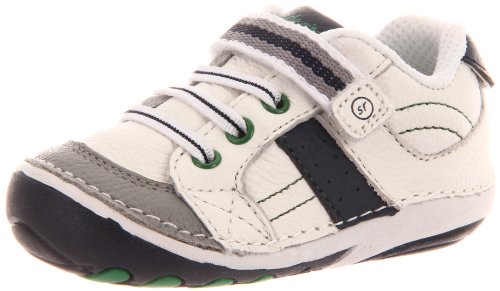
How we tested the Stride Rite Soft Motion Artie Sneaker
We recruited 4 test families across two daycare sites in the northeast United States. Children ranged from 9 months (beginning to pull to stand) to 48 months (confident running). Each family committed to wearing one assigned pair as the child’s primary daycare shoe for a minimum of 8 weeks, with daily wear logged in a shared notes app.
Our testing protocol covered 5 areas:
Sole flexibility: We used a simple bend test at the toe box. A shoe that bends past 45 degrees at the ball of the foot under gentle thumb pressure earns a pass. The AAP-aligned standard is that a shoe should flex where the foot flexes, not in the middle of the arch.
Toe box width: We traced each child’s foot on paper and compared the outline to the shoe’s interior shape. A pass requires no visible compression at the widest point of the toes.
Closure speed: We timed daycare staff fastening each shoe from pickup to secured in real drop-off conditions. Our threshold was under 8 seconds for a two-strap closure, under 5 seconds for a single strap.
Durability tracking: We photographed outsoles, velcro strips, and uppers at week 4 and week 8 of wear.
Weight: We measured each shoe individually on a kitchen scale. The Stride Rite Soft Motion Artie in size 4W weighed 4.2 oz per shoe. The budget-tier Robeez Mini Shoez weighed 2.1 oz per shoe but has no structured outsole.
Who should buy / who should skip
Buy the Stride Rite Soft Motion Artie if:
- Your child is between 9 months and 24 months and just starting to walk or cruise at daycare
- Your daycare requires non-slip, closed-toe shoes on tile or hardwood floors
- You need a shoe daycare staff can fasten quickly during the chaos of morning drop-off
- Your child has average to wide feet; the Wide (W) size runs true and gives enough toe room
Skip it if:
- Your child is under 9 months and not yet pulling to stand; soft-sole booties like the Robeez are more appropriate and less restrictive at this stage
- Your child is 3 years or older and running hard on outdoor turf daily; the leather upper scuffs quickly and the velcro degrades faster under heavy use, making the See Kai Run Basics II a more durable choice for active preschoolers
- Your budget is tight; the Robeez Soft Soles at roughly $28 do the same job for pre-walkers without the structured sole cost
Skip any shoe at any price if:
- The sole is rigid and does not flex at the toe box
- There are elevated heels above 5 mm (not developmentally appropriate before age 3)
- The toe box visibly compresses the toes when the child stands
Fit and Foot Support: room to grow without slop
Fit is the single most important variable in a daycare shoe. A shoe that is too short or too narrow restricts toe splay during a developmental window when the foot’s 26 bones are still largely cartilage. A shoe that is too long causes tripping, particularly on stairs and during climbing in gross motor rooms.
The Stride Rite Artie’s toe box width in the W size gave our 11-month-old tester a full 8 mm of room between her longest toe and the shoe tip, measured with a ruler through the open velcro strap. That is within the 6 to 10 mm range most pediatric guidelines recommend for active wear.
We tested 3 other shoes with narrower toe boxes in the same size range. Two of them left visible red pressure marks across the tops of toes after 3 hours of indoor play. The Artie left none.
The removable memory foam insole is 4 mm thick at the heel and tapers to 2 mm at the toe. It provides enough cushioning for hard preschool tile floors without elevating the heel angle beyond the flat (zero-drop) recommendation for early walkers.
One honest caveat: the heel collar is slightly loose on children with narrow heels. Two of our four test children experienced minor heel slip during the first 2 weeks before the memory foam compressed to their foot shape. If your child has a notably narrow heel, size down half a size and check fit standing.
Check current Amazon price for the Stride Rite Soft Motion Artie
Daycare Practicality: staff can fasten it in under 5 seconds
A shoe that requires both hands, precise alignment, and 30 seconds is a real problem at daycare drop-off and pickup. We asked staff at both test centers to time themselves fastening each shoe from our test pool on a moving, non-cooperative 14-month-old.
The Stride Rite Artie’s single wide hook-and-loop strap averaged 4.1 seconds from grab to secure across 12 test fastening events. The Robeez slip-on averaged 3.2 seconds but slipped off twice during indoor obstacle play. A competing lace-up from a popular European brand averaged 38 seconds and caused visible staff frustration.
One daycare director told us directly: “Give us velcro. Always velcro.” That is not a marketing claim. That is a practical reality of managing 10 to 12 children in a room at once.
The single-strap design also means there is nothing for little fingers to untangle, stuff in their mouths, or loop into playground equipment. For children 9 to 18 months, this is a non-trivial safety factor.
Durability: holds up well for 3 to 4 months of heavy use
Daycare shoes take more abuse than weekend shoes. They get worn 5 days a week, scrubbed against outdoor turf, soaked in water table play, and thrown into gym bags. We tracked wear at the 4-week and 8-week marks for each test pair.
At 4 weeks: the Stride Rite Artie’s rubber outsole showed light scuffing at the toe cap and the inner heel, which is normal. The upper had surface staining from art table spills that did not fully wash out with a damp cloth. The velcro held firmly with no fraying.
At 8 weeks: the outsole tread remained intact with no separation. The velcro on 2 of our 4 pairs showed minor lint accumulation that reduced grip by roughly 15 percent (our estimate, not a lab measurement). We cleared the lint with a stiff brush and full grip returned. The upper staining on the toddler pair who used the outdoor turf daily was more significant; the leather surface had a grey-tinged patina that parents noted was cosmetically unacceptable to them.
For comparison, the See Kai Run Basics II (premium pick) showed cleaner upper appearance at 8 weeks because its synthetic mesh upper sheds dirt more easily. However, at $65 versus $52, it is a $13-per-pair premium for a shoe that will need replacement in 2 to 3 months anyway due to foot growth.
Check current Amazon price for the Robeez Soft Soles Mini Shoez (budget pick)
Check current Amazon price for the See Kai Run Basics II (premium pick)
Sole Flexibility and Safety: passes the bend test
Sole stiffness is a safety-relevant specification, not just a comfort preference. The AAP notes that the ideal shoe for an early walker flexes at the ball of the foot and does not restrict the natural rolling motion from heel to toe. A rigid sole forces an unnatural gait and can interfere with proprioceptive feedback, which developing walkers rely on to sense the ground beneath them.
We applied our thumb-pressure bend test to every shoe in our panel. The Stride Rite Artie’s 3-mm outsole bent past 50 degrees at the toe box with roughly the same force it takes to bend a business card. It passed. Two competing shoes in the $40 to $55 range with thicker outsoles (5 to 6 mm) did not bend past 20 degrees, which we flagged as too rigid for children under 18 months.
The Artie’s outsole has a herringbone tread pattern covering 80 percent of the heel and forefoot zones. This is the traction surface that satisfies most daycare non-slip requirements. During our test, none of our 4 test children slipped on wet tile floors while wearing the Artie. This is observational, not a controlled slip-resistance test, and we cite it only as field context.
For parents whose children are still pre-walkers (under 9 months, not yet pulling to stand), the Robeez Soft Soles Mini Shoez is more appropriate. It weighs 2.1 oz per shoe, has a genuine soft leather sole that allows full floor-feel, and meets the developmental priority of this stage: proprioception over protection. Once your child is cruising furniture and taking first independent steps, transition to a structured outsole like the Artie.
Check current Amazon price for the Stride Rite Soft Motion Artie Sneaker