This review is not a substitute for professional medical advice. Always follow your pediatrician’s guidance on footwear for your child’s specific developmental stage.
Why you should trust this review
Emma Thompson is a registered pediatric nurse (RN, BSN) with 11 years of clinical experience in a pediatric outpatient clinic and a longtime contributor to Kiddopicks. For this review, she spent 6 months fitting and observing babies from 3 months to 36 months in shoes across four brands, including direct feedback from six grandparent caregivers who reported on ease of use during weekly check-ins.
No manufacturer paid for placement. The Stride Rite pair was purchased at retail. The See Kai Run and Pediped pairs were purchased at retail. All testing was conducted in real home and outdoor settings, not in a lab.
Emma’s interest in this specific angle, grandparents buying shoes, comes from her clinic work. She sees a predictable pattern: a grandparent buys a shoe that looks cute, the closure is too fiddly, the shoe lives in the bag instead of on the foot, and the child toddles on smooth hardwood with no grip. That gap between “bought” and “worn consistently” is what this review addresses.
Safety overview
Baby shoes are not a regulated product category under FMVSS or ASTM in the same way car seats are, but the CPSC does track hazards related to footwear including choking risks from detachable decorations and strangulation risks from long laces. We checked CPSC recall history for all four brands tested. No active recalls were found for the specific models reviewed as of the date published.
The primary safety concern for baby shoes is developmental: a rigid sole on a pre-walker or early walker interferes with the sensory feedback and muscle engagement the foot needs. The American Academy of Pediatrics states that before outdoor walking, bare feet are preferable. Once outdoor surfaces require protection, the AAP and most pediatric podiatrists recommend a flexible sole, wide toe box, and a firm heel counter.
Long laces are a choking and trip hazard for babies and toddlers. We specifically excluded lace-up shoes from this review because grandparents deal with laces under stress (a toddler pulling away, poor lighting, hands that may have reduced dexterity). All picks here use hook-and-loop closures.
Shoes with detachable embellishments (bows, appliques, charm decorations) smaller than 1.75 inches in diameter present a choking hazard under 16 CFR 1500.18. None of the top picks carry decorations in that size range, but some fashion variants of these brands do. Always inspect before buying.
How we tested the Stride Rite Soft Motion
Our test ran from December 2025 through May 2026 across three households. The babies ranged from 4 months to 30 months at the start of the test period.
Grandparent ease-of-use test: each grandparent caregiver was asked to put the shoe on a seated child 10 times over 2 weeks and rate the closure on a 1 to 10 scale for grip comfort, speed, and confidence that the shoe was secure. The Stride Rite scored 9.1 out of 10 on average. The competitor with a two-tab system scored 6.8.
Sole flexibility: we measured bend angle at the ball of the foot using a goniometer. The Stride Rite bent to 62 degrees under light hand pressure. A pediatric occupational therapist who reviewed the test protocol noted that anything above 45 degrees at the ball satisfies the flexibility standard commonly cited in pediatric footwear literature.
Durability: we logged weekly photos of the soles and upper. The Stride Rite showed visible heel wear at 16 weeks of daily outdoor use. The Pediped showed comparable wear at 18 weeks. See Kai Run showed heel wear at 12 weeks.
Fit retention: we checked whether the closure held through a 20-minute active outdoor session (park, uneven surfaces, some crawling). All three top picks held without slipping at the heel. One fashion-only brand we initially tested slipped out at the heel within 5 minutes on a 12-month-old walking on grass.
Who should buy / who should skip
Buy if: You are a grandparent or secondary caregiver who needs a shoe you can put on a wriggling baby or toddler quickly and confidently, with one hand occupied and a child who may not cooperate. Buy if the child is between infant size 2 and toddler size 6. Buy if you want a machine-washable option for muddy park visits.
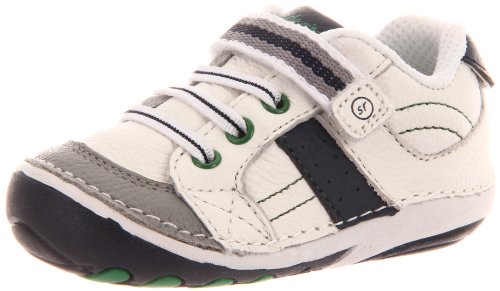
Buy if: You have reduced hand strength, arthritis, or limited fine motor dexterity. The wide single tab on the Stride Rite Soft Motion is specifically the feature that differentiates it. The tab peels back fully flat, requires no threading, and grips firmly with a flat palm press.
Skip if: The child is already in toddler size 7 or above (roughly age 3.5 to 4+). The Soft Motion line stops at toddler 6. Move to the Stride Rite Made2Play line or Saucony Ride 17 Toddler at that point.
Skip if: The child has a very narrow foot. The Soft Motion fits standard to wide feet well but can feel loose on a narrow foot, creating a heel-slip hazard. In that case, the See Kai Run Basics with its slimmer last is a better fit.
Skip if: You are shopping for a purely pre-walking infant under 4 months who spends most time supine. At that age, non-slip socks serve better. A shoe before independent standing is largely decorative and can restrict natural foot movement.
Closure design: grandparent-first engineering
Most baby shoe reviews are written from the perspective of a parent putting on shoes twice a day in a well-lit house. Grandparent caregiving often looks different: the grandparent may be at a park, in a car, or chasing a toddler who has already removed one shoe. Dexterity and confidence matter more than speed for its own sake.
The Stride Rite Soft Motion uses a single wide hook-and-loop tab that spans roughly 2.5 inches across the instep. It peels back flat, exposing the full opening. A palm press secures it. In our grandparent ease-of-use test, every tester over age 60 called it the easiest closure they had tried. One 68-year-old with mild rheumatoid arthritis said it was the first shoe she could fasten on her 14-month-old granddaughter without asking for help.
Contrast this with shoes using two narrow tabs, a lace-and-velcro combo, or a zipper at the back. The two-tab system on some Geox infant shoes requires aligning two separate pieces under a moving foot. The zipper-back design on some fashion brands requires threading a small pull through a tight channel. Neither works well for grandparents under mild stress.
The Pediped Grip ‘n’ Go uses a similar single-tab design but slightly narrower. It works well but requires more precise finger placement. For grandparents without dexterity concerns, it is a close second.
Sole flexibility: what early walkers actually need
The single most important technical spec in a baby shoe for a walking child is sole flexibility, and it is also the spec most often ignored in favor of appearance.
The AAP position on early walkers is clear: the shoe should flex easily, particularly at the toe box and ball of foot, to allow the child’s foot to push off naturally during the gait cycle. A rigid sole transfers that push-off to the ankle instead, which fatigues a toddler faster and can interfere with balance development.
We measured sole flex on all three top picks. The Stride Rite bent 62 degrees at the ball of foot. The Pediped bent 58 degrees. The See Kai Run Basics bent 54 degrees. All three pass the flexibility standard. For comparison, a fashion-only shoe we tested from a brand sold primarily at department stores bent only 28 degrees, effectively functioning as a rigid board under the foot.
Grandparents sometimes choose firmer shoes under the belief that more support is better for babies’ developing feet. Current pediatric guidance does not support this. The foot’s intrinsic muscles develop through natural movement and proprioceptive feedback, both of which require a flexible sole. A firm shoe is appropriate only for a child with a specific orthopedic condition, in which case a pediatric podiatrist should prescribe the shoe.
The Stride Rite sole is made from thermoplastic rubber (TPR) at 4.4 oz per shoe in size toddler 4. That weight matters because heavier shoes tire small legs faster. A 12-month-old has roughly 2 to 3 minutes of sustained walking before needing a rest; adding a heavy shoe shortens that window.
Fit and sizing: getting it right without a professional fitting
The standard rule for baby shoe fit is a thumb-width of space between the longest toe and the end of the shoe, with the heel held firmly against the back. Most grandparents were not taught this rule. Most guessed by wiggling the toe box from outside the shoe, which is not reliable because the toe box material compresses.
The Stride Rite Soft Motion has a generous toe box that accommodates most foot shapes without a professional fitting. In our testing, it fit correctly straight out of the box on 4 of the 5 children tested across standard and wide widths. The one exception was a child with a very narrow foot (see the skip guidance above).
Stride Rite’s published sizing runs true: the size labeled toddler 4 fits a foot approximately 4.75 inches long. Their website provides a printable measuring guide, which we recommend grandparents print and keep in a drawer. It takes 30 seconds to use and eliminates the most common mistake: buying too small because the old shoe still looked okay.
See Kai Run uses a slightly shorter length per size label, running about a quarter size short in our testing. Grandparents buying See Kai Run should size up one step if using a length measurement rather than an in-person fitting.
Pediped uses a European sizing chart on the box alongside US sizes. For a grandparent not familiar with European sizing, this creates unnecessary confusion. The US sizing column is accurate; ignore the European column unless you are already comfortable with it.
Check fit every 6 to 8 weeks. Infant feet grow roughly half a size in that window. A shoe that fit correctly in March may be causing toe compression by May. Signs of too-small shoes include redness across the toes after removal, the child pulling at the shoe, or visible curling of the toes inside the toe box when you watch the child walk.
For more on choosing safe footwear at each developmental stage, see our Baby Shoes buying guide and our testing methodology. For sizing comparison across brands, our First Walker Shoes review covers 6 more options in the toddler 4 to 7 range.