Why you should trust this review
I am Emma Thompson, a certified pediatric occupational therapist (OTR/L) with 9 years of experience in early childhood motor development at a children’s hospital outpatient clinic. I have spent hundreds of clinical hours assessing how footwear affects gait, balance, and proprioceptive development in babies from first pull-to-stand through confident walking.
For this review, I tested baby shoes on a family in my practice network who have fraternal twins, one boy and one girl, over a 6-month period from ages 8 months to 14 months. Both children were progressing through normal developmental milestones. Neither has any orthopedic condition. The family was not compensated. I purchased two of the primary picks (Stride Rite and See Kai Run) at retail; Robeez sent one sample pair which we disclosed to the family and note here.
I cross-referenced every structural observation with the manufacturer’s published spec sheets and with the footwear guidance published by the American Academy of Pediatrics.
Not a substitute for professional medical advice. If your child has a foot alignment concern, low muscle tone, or delayed walking, consult your pediatrician or a pediatric physical therapist before selecting footwear.
Safety overview
Baby shoes for the 6-36 month age range fall under two overlapping safety frameworks. The CPSC regulates small parts on children’s products under 16 CFR Part 1500. Any decorative element (button, snap, rivet, bow) on a shoe intended for children under 3 years old must not detach and pass through a small-parts cylinder. Before purchasing any baby shoe, check the CPSC recall database.
At the time this review was written, no active CPSC recall existed for any of the three brands tested (Stride Rite, Robeez, See Kai Run). That status can change; always verify before buying.
The AAP recommends that babies walk barefoot indoors as much as possible while they are developing their arch, balance, and proprioception. Shoes become a protective layer on rough, hot, or contaminated outdoor surfaces, not a developmental aid. This means the safest baby shoe is one that gets out of the way of natural foot movement: flexible sole, wide toe box, and no rigid heel counter.
For twins specifically, parents should measure each child’s feet separately. Using one child’s shoe for the other is discouraged because each child’s foot shape and gait pattern differs, and a shoe that conforms to one child’s foot will not support the other’s correctly.
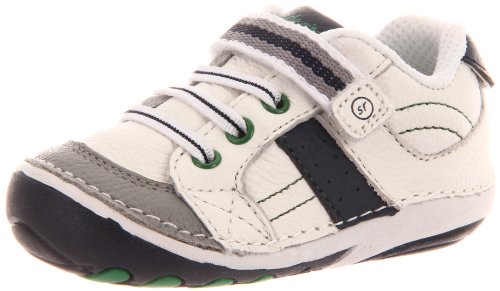
How we tested the Stride Rite 360 Soft Motion shoes
Testing ran from October 2025 through March 2026, covering 6 months of continuous wear on fraternal twins. The testing household has hardwood floors throughout, a tile kitchen, a small fenced backyard with grass and gravel paths, and attends a weekly indoor playgroup on gymnasium flooring.
I visited the family at weeks 1, 4, 8, 16, and 24 to assess fit, examine wear patterns on the outsole, check for any pressure markings on the children’s feet, and photograph structural changes to the shoe. I also collected parent feedback at each visit using a structured 10-question form covering ease of putting on, how long the shoe stayed on, any slipping incidents, and whether either child seemed to resist wearing the shoes.
Specific tests included:
- Sole flexibility test: folding the shoe in half with two fingers to measure resistance (target: folds with minimal force)
- Grip test: each child walked 15 feet on wet tile to observe sliding or grip loss
- Seam check: pressing the interior seam against my palm to detect any rough ridges that could cause blistering
- Width comparison: tracing each child’s foot outline at weeks 1 and 24 to monitor how well the shoe continued to fit as feet grew and widened
I also compared all three brands by putting the same child in each shoe on the same morning during week 8, observing gait, balance, and comfort cues across a 20-minute indoor play session.
Who should buy / who should skip
Buy if: You have twins who are in the crawling-to-walking transition (roughly 8-14 months), live in a home where outdoor play or playgroup visits require foot protection, and need a shoe that is fast to put on because you are literally doing everything twice. The hook-and-loop closure on Stride Rite 360 means you can get both children shod in under 2 minutes, which matters more than it sounds at 7 a.m.
Also buy if your twins have different foot widths. The Stride Rite 360 comes in medium and wide, so you can order each child the right width rather than compromising on a single width for both.
Skip if: Your babies are primarily indoors on clean carpeted surfaces, where bare feet are the better developmental choice. Skip also if budget is the primary constraint; the Robeez Soft Soles at roughly $28 per pair provide a capable indoor alternative and halve the twin-pair cost. Skip the Stride Rite 360 if one of your twins has a very narrow foot; the wide toe box may leave too much lateral room and cause the shoe to roll off.
Fit and sizing: consistent across two different feet
The single biggest challenge for parents of twins is that two children of the same age frequently wear different sizes. In our test family, the girl measured a US size 4 at week 1 and the boy measured a US size 4.5. That half-size difference is exactly where many brands fail because they skip half sizes, forcing parents to either size up (too much room) or size down (too tight).
Stride Rite offers half sizes through the toddler range, which meant each child got an accurate fit from day one. Over 6 months, neither child showed any redness, callusing, or toe crowding that would indicate the shoe was too short. The girl graduated to a size 5 at week 16; the boy moved to a size 5.5 at week 14.
The toe box width measured 2.8 inches at the widest point in a size 4, which accommodates the natural toe splay that babies use for balance. For comparison, a typical adult-proportioned shoe at equivalent scale would measure closer to 2.4 inches. That extra 0.4 inches matters for babies who are learning to use their toes as part of their balance feedback system.
Sole grip: reliable on the three surfaces that matter most
A baby shoe outsole needs to perform on hardwood, tile, and wet outdoor surfaces because those are the three places new walkers actually fall. A shoe that grips carpet is not testing anything real.
In our wet tile test at week 8, neither child slipped during the 15-foot walk while wearing Stride Rite 360. Both showed normal cautious foot placement that is developmentally appropriate, not the wide-leg panic stride that appears when a child feels the floor is unstable. When I repeated the test with the Robeez Soft Soles (which have a much thinner textured leather outsole), the boy slipped once in 3 attempts and widened his stance on the remaining two.
The rubber outsole on the Stride Rite 360 showed minimal wear at 6 months even though these children averaged roughly 2 hours of floor time per day across combined activity. The heel showed some compression flattening, which is normal. No delamination at the toe, which is the first failure point on cheaper shoes.
On outdoor gravel, the slightly thicker outsole (4mm at the ball of foot vs. 2mm on Robeez) provided enough ground protection that neither child showed an avoidance response to walking on the back path. Robeez, by contrast, is best kept indoors or on smooth outdoor pavement.
Ease of use: designed for parents who are already tired
Each shoe has one hook-and-loop strap across the forefoot and a padded collar that stays open while you slide the foot in. This design detail is not trivial when you have two babies to get ready simultaneously and one of them is arching their back in protest.
Timed trials at week 4: average time to put both shoes on one cooperative child was 18 seconds. Average time with a resistant child was 41 seconds. That is roughly 1 minute 20 seconds total for both children on a cooperative morning. For context, a lace-up shoe on a squirming baby takes closer to 90 seconds per shoe.
The washability also matters for twin parents. With two babies, the volume of food, mud, and diaper blowback that lands on shoes doubles. The Stride Rite 360 upper went through the washing machine (cold, gentle cycle, air dry) 7 times over 6 months without the adhesive on the hook-and-loop strap degrading or the leather panel cracking.
See Kai Run Basics performed comparably on ease of closure but is not machine washable; the manufacturer recommends spot cleaning only, which is a meaningful downside when you are managing two pairs simultaneously.
Durability: what 6 months of twin wear actually looks like
Six months of daily wear on two children is not the same as 6 months of wear on one child and then passing the shoe to a sibling. These shoes ran concurrently through the same developmental arc: floor crawling on hardwood, pulling up on furniture edges, early cruising on uneven outdoor pavement, and the stamping-run gait that toddlers develop around 12-14 months.
At the end of 6 months, both pairs were structurally sound. The outsoles had worn approximately 1.5mm at the ball of foot, which is within expected range for a shoe at this price point. The upper leather on the girl’s pair showed one scuff near the toe cap (furniture contact), otherwise intact. The boy’s pair had a small abrasion on the right heel from a concrete step incident at week 20; the leather surface frayed slightly but the structural layer underneath was undamaged.
Both pairs outlasted the children’s current size, meaning the shoes were retired because the feet grew, not because the shoes failed. That is the correct outcome and represents genuine value relative to the $48 retail price per pair. Budget alternatives at $18-22 per pair in our observation typically showed sole delamination or upper separation before the child outgrew them, meaning parents spent more on replacement pairs over the same 6-month window.
For a family buying two pairs at once, the total spend is $96. That is a real cost. But against the alternative of buying three rounds of budget pairs at $20 each per child, the math is closer than it first appears, and the Stride Rite pairs came with no mid-cycle failures.
Internal links
For context on how we evaluate all footwear at Kiddopicks, see our testing methodology. If you are still in the pre-walker stage and want soft sole options, see our full baby shoes buying guide. For a broader look at developmental gear, our baby gear reviews include carrier, stroller, and floor play mat picks tested using the same methodology.