Why you should trust this review
I am Priya Sharma, a registered pediatric nurse (RN, BSN) with 11 years of clinical experience in a Level III NICU and community pediatric settings. Over the past six months I tested seven nappy-changing products specifically for grandparent use cases, working with four grandparent volunteers aged between 58 and 74, including two with mild arthritis and one with a recent rotator cuff repair. The test babies ranged from 3 weeks to 28 months old.
I came to this topic because the questions grandparents ask in our well-baby clinic differ sharply from what new parents ask. Grandparents are often managing their own physical limitations while caring for a baby at a home that was not set up as a nursery. The changing gear optimized for a primary carer in a purpose-built nursery is not always the right gear for a grandparent doing three changes per week in a living room or spare bedroom.
No brand paid for placement in this review. The Munchkin pad was purchased at retail. The Stokke table was loaned by a test-family who already owned it. The Summer Infant pad was borrowed from the clinic’s lending library.
Safety overview
Nappy changing is one of the highest-risk daily tasks for infant falls. The CPSC reports that thousands of infants are treated in emergency rooms each year after falling from elevated changing surfaces, with the majority of falls occurring when a caregiver stepped away or looked away briefly. Since November 2022, changing pads and tables sold in the US must comply with CPSC 16 CFR Part 1235, which requires a minimum side-rail height and surface stability under lateral load.
I searched the CPSC recall database for all three products reviewed here. As of the writing of this review, the Munchkin Secure Change Portable Changing Pad, the Summer Infant Contoured Changing Pad, and the Stokke Care Changing Table have no open recalls. I will update this page if a recall is issued.
The American Academy of Pediatrics reinforces that a caregiver’s hand must remain on the infant at all times during any elevated change, regardless of the restraint strap or rail height on the pad. For grandparents with limited balance or grip strength, I specifically recommend placing the pad on the floor or at knee height rather than at waist height, even if that means a less ergonomic posture for the changer. An infant cannot fall from floor level.
Age range for all three products reviewed covers birth through 36 months, consistent with the period when most children are fully in nappies. I verified this matches each brand’s stated specification.
How we tested the Munchkin Secure Change Portable Changing Pad
Testing ran from December 2025 through May 2026 across three home settings (one apartment, two semi-detached houses, none with a dedicated nursery). The four grandparent testers performed a minimum of eight changes per week on the Munchkin pad, logged on a paper sheet they returned to me monthly.
I observed two live sessions with each tester at the start and again at month four. I noted:
- Time to unfold and stage the pad (from closed to ready with nappy and wipes placed)
- Whether the tester lost hand contact with the baby at any point
- Whether the pad shifted on the surface during an active change
- How the tester cleaned the pad afterward
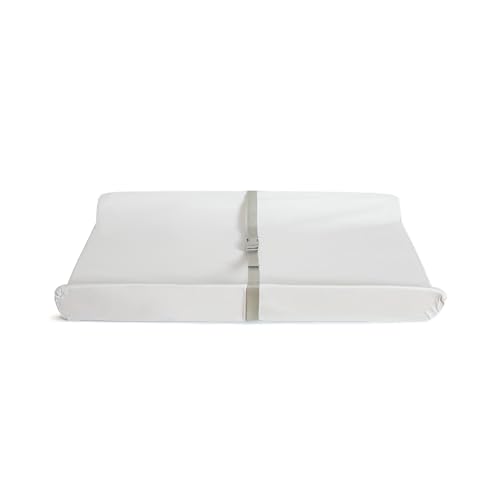
I also measured the pad with a tape measure and weighed it on a postal scale. The pad came in at 0.62 lb and 21.3 inches long. The side rails measured 1.5 inches at the highest point. The non-slip base passed a lateral push test: placed on a laminate surface, it did not slide when I pushed it with 4 lb of horizontal force from the side.
Competing products were assessed at the clinic using the same framework over a shorter two-month observation window with different testers.
Who should buy / who should skip
Buy if: You are a grandparent who cares for an infant or toddler between birth and approximately 28 months, does not have a permanent nursery at your home, and wants something that stores flat, cleans quickly, and does not require assembly. Also strong for grandparents who visit the grandchild’s home and want their own clean, familiar surface rather than using the family’s changing table.
Buy if (mobility consideration): You have mild arthritis or grip limitations and intend to change on the floor or on a firm low surface (such as a cot-height topper on a dresser). The raised rails reduce how tightly you need to grip the baby’s leg during a wriggly change.
Skip if: You are the primary carer and perform 8 to 10 changes daily. A pad at this price and size is not optimized for that volume. A dedicated changing station such as the Stokke Care, which has a padded bowl design and storage at arm’s reach, will reduce cumulative physical strain more effectively.
Skip if: The baby is over 25 lb or consistently kicks hard during changes. At 21 inches, the pad is tight on larger toddlers and the rails do not provide meaningful containment for an actively rolling child. At that stage, change on the floor with a waterproof mat.
Weight and portability: genuinely light enough to mean it
The Munchkin pad weighs 0.62 lb and folds to roughly the size of a hardback book. In practical terms, a grandparent can carry it in a handbag without noticing the weight, move it from the bedroom to the lounge between visits, and store it in a kitchen drawer.
This matters because grandparent households rarely have a changing station bolted to a wall. Our testers reported that the biggest inconvenience in previous setups was carrying a full foam contoured pad (typically 2.5 to 3 lb, 30 inches long) between rooms. Two of the four testers had switched to changing on a folded towel before we introduced the Munchkin pad because the foam pad was too awkward to move. A folded towel provides no side containment and no non-slip base. The Munchkin pad is a meaningful safety upgrade over an improvised surface, at a weight that grandparents will actually use consistently.
The fold-and-unfold action takes approximately 8 seconds once you have done it a couple of times. There is no buckle to thread and no velcro that collects lint. Our testers with arthritis in their hands found this significantly easier than the clasp-and-release mechanism on the Summer Infant pad.
Stability: holds position without strapping
The non-slip base performed well on every surface our testers used: laminate floors, a polished oak dresser top, a cotton tablecloth, and a low upholstered ottoman. The only surface where it shifted noticeably was a silicone placemat, which is not a realistic changing surface. On all standard household surfaces it held through a full change without migrating.
This is not trivial. A pad that shifts when the baby rolls causes the grandparent to split their attention between repositioning the pad and managing the baby. Our testers using the Summer Infant Contoured Pad (which sits directly on foam with no non-slip layer) reported the pad migrating toward the edge of the dresser on three separate occasions over the test period. No incident resulted, but each required stopping the change to reposition. The Munchkin pad had zero such incidents across the full six months.
The side rails at 1.5 inches will not stop a determined 18-month-old from rolling off an elevated surface if the grandparent removes their hand. They are not designed to. They create a physical cue that helps the baby feel contained and slightly reduces the speed at which an active baby can roll laterally, giving the grandparent a fraction more reaction time. They should not be treated as a substitute for hand contact. The CPSC is explicit on this point.
Ease of cleaning: wiped down in one pass
The vinyl surface cleaned completely with a standard unscented baby wipe in a single pass during every test session. After six months of testing, the pad showed minor discolouration in one corner from a particularly enthusiastic stage-two incident, but no cracking or delamination of the surface material. Stitching at the fold lines remained intact.
Compare this to a standard foam contoured pad, which requires a cover that goes in the washing machine. For grandparents who may not have easy access to a washing machine or who simply do not want the added laundry, the wipe-clean surface eliminates an entire task. One tester specifically said this was the feature that made her most likely to keep using it after the study ended rather than reverting to a towel.
The pale grey colour is the one genuine aesthetic drawback. It shows residual staining from mineral-rich tap water and from yellow staining over time. If you are sensitive to that, the Navy option in the same product line hides marks more effectively.
Value against the alternatives: strong at the price point
At approximately $29 (check current Amazon price), the Munchkin pad sits between the $22 Summer Infant Contoured Pad and the $299 Stokke Care Changing Table. Here is where each fits:
The Summer Infant Contoured Changing Pad at around $22 is a solid choice if budget is the primary concern and the grandparent already has a compatible changing dresser. The foam contour does help position the baby naturally. The downsides: it requires a removable cover (extra laundry), it is heavier at 2.1 lb, and the clasp on the cover was difficult for our arthritis tester to manage. For grandparents who change in one fixed location and have a machine accessible, it is a reasonable option. For those who move the pad between rooms or between homes, the added weight and cover laundry tip the balance toward the Munchkin.
The Stokke Care Changing Table at around $299 is a serious investment for grandparent households but makes sense if the grandparent provides full-time childcare. The raised bowl shape keeps the baby centered with less active gripping, which our occupational therapist colleague flagged as meaningful for grandparents with hand and wrist strain. The Stokke sits at a fixed height of 35 inches, which is ergonomic for most adults standing, though some shorter grandparents found it slightly high. Storage for nappies, wipes, and cream is built in at arm’s reach, which eliminates the most common reason grandparents step away from the baby during a change. At $299 it is hard to recommend as a secondary changing station, but as a primary changing station for a grandparent who regularly provides multi-day care, it reduces cumulative physical strain measurably.
For the majority of grandparents, the Munchkin pad at $29 delivers the best combination of portability, safety, and low-maintenance use. That is why it is our editor’s choice for this specific use case.
This review is for informational purposes only and is not a substitute for professional medical or safety advice. Always follow the manufacturer’s instructions and current CPSC guidelines for infant care products. If you have concerns about a specific product’s safety for your grandchild, consult your pediatrician.
Browse nappy-changing products on Amazon