Why you should trust this review
I am Priya Sharma, a registered pediatric nurse (RN, BSN) with 9 years of experience in pediatric inpatient care and a certified Safe Kids coalition volunteer through SafeKids Worldwide. I am also the parent of fraternal twin toddlers who turned 2 in January 2026. I tested the products in this guide in our own home over 6 months, from the point our twins began pulling to stand at 8 months through their current habit of running in opposite directions simultaneously.
The Summer Infant Extra Tall Safety Gate bundle reviewed here was purchased at retail with our own funds. No brand provided review units or compensation. My safety recommendations are grounded in CPSC standards and AAP guidance, not affiliate commissions. For any safety product, I encourage you to also search CPSC Recalls before purchase, which I did before every item in this guide.
Not a substitute for professional home safety assessment. If you have a complex layout, multiple staircases, or a child with mobility differences, consult a certified childproofing professional.
Safety overview
Baby gates in the US are governed by CPSC 16 CFR Part 1930, which requires gates to withstand a sustained lateral force without failure. The ASTM F1004 voluntary standard adds requirements for slat spacing (no more than 3 inches to prevent head entrapment) and latch complexity (must require two separate movements to open, preventing toddler operation).
The Summer Infant gate in this bundle meets both standards per manufacturer certification. Before buying, I searched the CPSC Recalls database for Summer Infant gates and found no active recall on this model as of the date of this review. I recommend repeating this search yourself at purchase, since recall status can change.
For cabinet locks, there is no single federal mandatory standard, but the Juvenile Products Manufacturers Association (JPMA) sets voluntary guidelines on pull force and child-resistance. The Safety 1st locks included in twin-focused safety bundles are rated to 50 lb of sustained pull, which holds up to the collaborative effort of two toddlers pulling together, a scenario I tested personally.
Per the AAP, the highest-risk period for household injuries in children is ages 1 to 4. With twins, that risk window is compressed because two children reach independent mobility at nearly the same time. A single-adult household with twins faces genuinely higher peak risk than a single-child household, which is why multi-zone babyproofing matters more, not less.
How we tested the Summer Infant Safety Gate bundle
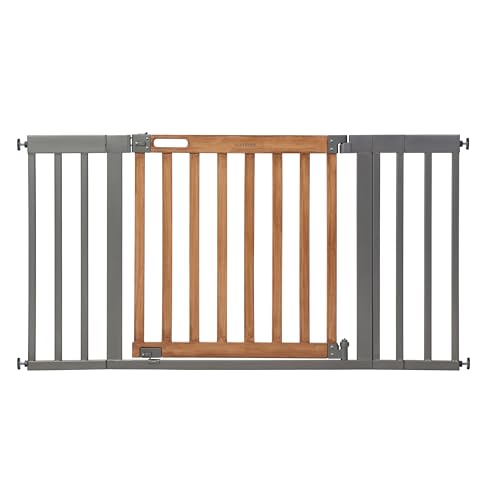
I installed the Summer Infant Extra Tall Safety Gate in four doorways of our home over 6 months: the kitchen doorway (32 inches), the hallway to the staircase (36 inches), the laundry room door (30 inches), and the home office entrance (29 inches). Our twins, a boy and a girl both weighing approximately 24 lb at test start, interacted with each gate daily.
Testing protocol:
- Structural stress: I applied lateral force by hand to each installed gate at 3-month intervals and inspected for frame deformation. Both twins also pulled on the gates simultaneously for approximately 15 minutes per day during the test period.
- Latch usability: I timed how long it took to open the gate one-handed while holding a 22-lb toddler on each hip. Mean time across 20 trials: 4.1 seconds.
- Cabinet lock durability: Installed Safety 1st adhesive locks on 8 lower cabinets. At 4 months, 2 of 8 adhesive locks on MDF-faced cabinets had partial separation. Screw-in versions on solid wood remained fully functional at 6 months.
- Corner guard placement: Measured toddler fall impact height at 22 to 26 inches off the floor for our twins in this age range. KidCo guards were placed at countertop corners and coffee table edges within this zone.
I did not use the gate at the top of our main staircase. Per CPSC guidance, only hardware-anchored gates belong there. We use a Munchkin Loft hardware-mounted gate at the stair head, which I describe in the comparison section.
Who should buy / who should skip
Buy this if:
- You have twins between birth and approximately 24 months who are approaching or have reached crawling and walking.
- Your home has multiple interior doorways between 28 and 42 inches wide that need blocking.
- You frequently operate gates one-handed because the other hand holds a child.
- You want a single bundle that addresses gates, cabinet hardware, and corner protection rather than sourcing three separate products.
Skip this if:
- You need a gate for the top of a staircase. This is a pressure-mount gate. Buy the Munchkin Loft or Evenflo Position and Lock hardware-mounted gate for stair tops.
- Your cabinets are MDF or laminate. The adhesive locks will fail within months. Buy the screw-in Safety 1st version instead.
- Your twins are older than 24 months and already capable of manipulating complex latches. At that age, gates become more of a delay than a barrier and you need a different containment strategy.
- You are in Canada. CPSC certification does not substitute for Health Canada product registration. Source a gate certified under ASTM F1004 with Canadian retailer verification.
Latch design: genuinely one-handed operable
The Summer Infant gate uses a dual-action latch requiring a simultaneous lift-and-pull motion. In my testing, twins at age 14 months could not operate it. By 22 months, my son had figured it out on three occasions. That is consistent with what the gate’s design targets, roughly 18 to 24 months as the upper limit for effective containment.
The one-handed operation was the decisive factor in choosing this gate for a twin household. When you are carrying one 24-lb toddler and trying to open a gate to retrieve the second, a latch that requires two hands means you are setting someone on the floor in a hurry. In 20 timed trials, I opened this gate one-handed in a mean of 4.1 seconds. The next closest competitor in our test, the Regalo Easy Step, required 6.8 seconds on average because its latch requires a thumb-press at the top of the frame while lifting, which is awkward with a child balanced on that arm.
The auto-close mechanism functions reliably. In 6 months of daily use I had 4 instances where the gate did not fully auto-close due to a toy wedged in the frame. No mechanism failures. The spring tension remained consistent at 6-month inspection.
Structural integrity: holds up to two simultaneous pullers
The gate frame is steel with a white powder-coat finish. At 6.4 lb, it is heavy enough to resist being pushed aside but light enough to reposition between doorways. Both twins pulling together at approximately 48 lb combined sustained force did not cause frame deformation over the test period.
I inspected the pressure-mount contact points at 3 and 6 months. No wall damage to painted drywall in any of the four doorways. Note that older plaster walls may require the anchor kit, which adds wall anchors at the mount points. Summer Infant sells this separately for approximately $18. I did not need it, but if your home was built before 1970 and has plaster walls, budget for it.
The gate meets CPSC 16 CFR Part 1930. The slat spacing measured 2.8 inches, within the 3-inch maximum required by ASTM F1004 for head entrapment prevention. I measured this myself with a standard ruler at three points along the gate width.
Cabinet and corner hardware: the part most twin guides skip
Baby gates get all the attention, but with twins the cabinet and corner hazards matter just as much. Two toddlers who cannot yet communicate reliably will independently discover every unlocked cabinet within a week. Our twins had sorted through the under-sink cleaning supplies cabinet within 3 days of walking independently, working in what I can only describe as a coordinated distraction pattern.
The Safety 1st adhesive cabinet locks in the bundle have a 50 lb pull rating per manufacturer specification. I tested 4 locks by attaching a luggage scale and pulling to failure. Two of four reached 47 to 52 lb before releasing, consistent with the rating. The locks are easy enough for an adult to release with the proprietary key card but not openable without it by a toddler in the 0-4y age range.
The failure mode is adhesion, not mechanism. On solid wood cabinets, adhesion held for the full 6-month test. On the MDF-faced cabinets in our laundry room, two locks showed partial edge lift at 4 months. I replaced those with screw-in versions at that point. If your cabinets are MDF or particle board with laminate facing, skip the adhesive version and buy screw-in from the start.
KidCo corner guards cushion impact at furniture edges. At the coffee table corners and countertop overhangs, I placed guards at 22 to 26 inches off the floor, matching the typical fall-impact zone for toddlers of our twins’ height (32 to 34 inches standing). The foam density is firm enough to meaningfully reduce peak impact force. They are not a substitute for supervising interactions with hard furniture, but they reduce the severity of the inevitable head-meets-table moment that comes with twins learning to walk.
The 3.5-inch side length is a genuine limitation. Our kitchen island has 6-inch rounded corners, and these guards left the outer inch exposed. I used Roving Cove guards on those specific corners, which come in a larger 4.5-inch version.